

How much does Estonia e-Residency cost?
Applicants pay an e-Residency program fee of EUR 150 upfront during the online application. This non-refundable payment funds the background check, digital ID card production, smart card reader and PIN envelope. The card remains valid for 5 years and can be renewed.
Estonia’s e-Residency program is the world’s first government-issued digital identity available to anyone, regardless of nationality or place of residence.
Launched in December 2014, the program has grown into a cornerstone of Estonia’s digital economy strategy, enabling over 135,000 individuals from more than 170 countries to establish and manage EU-based businesses without ever setting foot in Estonia.
For digital nomads, freelancers and location-independent entrepreneurs, e-Residency eliminates the traditional barriers of geography, bureaucracy and physical presence that have historically made international business formation complex and expensive.
Through detailed analysis as of 2026, this guide covers the entire e-Residency program spectrum, including application mechanics, costs, functional range, operational limits and practical aspects of building and managing an Estonian company remotely. All content reflects the latest regulations and actual experience through the program’s first decade.
What E-Residency Actually Is
E-Residency is a transnational digital identity issued by the Estonian government. It takes the form of a government-issued smart card (similar in size to a credit card) containing a secure chip that stores your encrypted digital identity.
When used with a USB smart card reader and PIN codes, the card allows you to digitally sign documents with the same legal validity as a handwritten signature under EU eIDAS regulations.
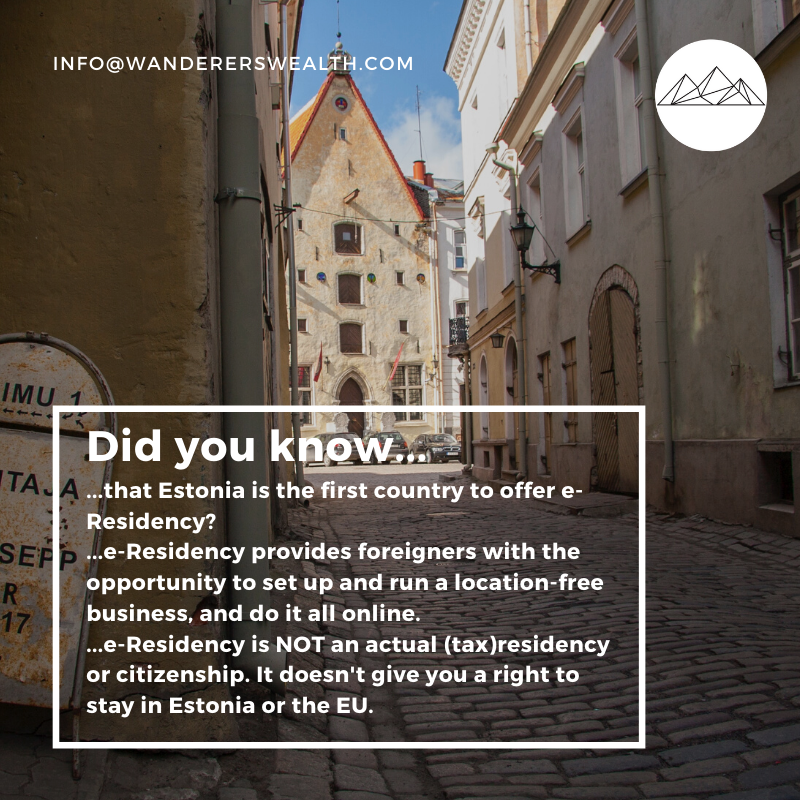
The term “e-Residency” is somewhat misleading. It does not confer residency in any legal, physical, or tax sense. You do not become a resident of Estonia. You do not receive a visa, a work permit, or any right to enter or remain in Estonia or the European Union.
What you receive is a digital tool that allows you to participate in Estonia’s digital ecosystem as if you were present in the country.
E-Residency functions as a secure digital key granting access to Estonia’s entire e-governance ecosystem. Business owners can use the same digital platforms that Estonian citizens operate to manage companies, sign documents, handle taxes and engage with government services. The tool itself is not the end point.
Key Capabilities
With an e-Residency digital ID, you can:
- Establish an Estonian private limited company (OU) online through the Business Register
- Digitally sign contracts, agreements and official documents
- File company tax returns and annual reports through Estonian Tax and Customs Board e-services
- Manage your company’s Business Register filings remotely
- Access Estonian banking and financial services (subject to each institution’s requirements)
- Encrypt and decrypt documents for secure transmission
- Authenticate your identity on Estonian e-services platforms
What E-Residency Does Not Provide
| Capability | Provided by E-Residency? |
|---|---|
| Digital company formation | Yes |
| Digital document signing | Yes |
| Tax filing access | Yes |
| Physical residency in Estonia | No |
| Right to enter Estonia or EU | No |
| Tax residency in Estonia | No |
| Citizenship or path to citizenship | No |
| Physical identification document | No |
| Travel document | No |
| Right to work as an employee in Estonia | No |
| Voting rights in Estonian elections | No |
| Access to Estonian healthcare | No |
Who E-Residency Is For
The program was designed for several distinct categories of international entrepreneurs, each with different motivations and use cases.
Digital Nomads and Remote Workers
Freelancers and remote workers who serve clients across multiple countries benefit from having a stable EU-based company structure. An Estonian OU provides a professional European business identity, access to SEPA banking for euro-denominated transactions, and a straightforward invoicing framework that EU clients recognize and trust.
Location-Independent Business Owners
Entrepreneurs who operate online businesses (SaaS products, e-commerce, consulting, digital services) can use an Estonian company as their primary or secondary business entity. The zero tax on retained profits makes Estonia particularly attractive for businesses reinvesting their earnings into growth.
Entrepreneurs from Countries with Complex Bureaucracies
Entrepreneurs operating in nations with unstable banking systems, currency restrictions or onerous regulations employ Estonian e-Residency to tap into European financial infrastructure and an open legal environment shaped by EU rules.
Companies Seeking EU Market Access
Non-EU businesses can use an Estonian OU as their European market entry vehicle, establishing EU presence for regulatory compliance, customer trust and access to the European Single Market.
The typical e-Resident is a technology professional or online service provider between the ages of 25 and 45, operating a business with clients in multiple countries and seeking a stable, efficient jurisdiction with minimal bureaucracy. Finland, Germany, and Ukraine have historically ranked among the top cumulative countries of origin for e-Residents.
Estonia suspended new e-Residency applications from Russian and Belarusian citizens in 2022 following the invasion of Ukraine, so recent application data is now led by countries such as Germany, Ukraine, France, Spain, Turkey, Italy and India.
Application Process
Step 1: Prepare Your Application
Before starting, gather the following:
- A valid passport or national identity card (must be valid for at least 6 months)
- A passport-quality digital photo (white background, neutral expression, no glasses)
- A brief motivation statement explaining why you want e-Residency and how you plan to use it
- A credit or debit card for the EUR 150 application fee
Step 2: Submit Online Application
Visit the official e-Residency portal (e-resident.gov.ee) and complete the application form. You will enter personal information, upload your photo and ID document, write your motivation statement and select your preferred pickup location from the list of Estonian embassies and consulates worldwide.
The motivation statement does not need to be lengthy, but it should clearly state your intended use. Common reasons include starting a company in Estonia, managing an existing Estonian company, or accessing Estonian digital services for business purposes.
Step 3: Pay the Application Fee
The application fee of EUR 150 is paid online during the application process. This fee is non-refundable regardless of the application outcome. Payment is processed by the Estonian Police and Border Guard Board.
Step 4: Background Check and Processing
The Estonian Police and Border Guard Board conducts background checks on all applicants. This includes verification of identity documents, criminal background checks and screening against international sanctions lists. Processing typically takes 3 to 6 weeks. You will receive email updates on your application status.
Step 5: Approval and Card Production
If approved, your e-Residency smart card is produced and shipped to your selected pickup location. You will receive an email notification when the card is ready for collection. Production and shipping typically take an additional 1 to 2 weeks after approval.
Step 6: Pick Up Your E-Residency Kit
Pick up your e-Residency kit in person at the Estonian embassy or consulate of your choice. Your kit contains a smart card, a USB card reader and PIN envelopes holding PIN1 for authentication and PIN2 for digital signing - both are sealed. Present the same ID document you submitted with your application. Some locations require reservations, so verify what your pickup location requires.
| Application Stage | Duration | Cumulative |
|---|---|---|
| Online application submission | 30 minutes | Day 1 |
| Background check and processing | 3-6 weeks | Week 3-6 |
| Card production and shipping | 1-2 weeks | Week 4-8 |
| Card pickup at embassy | 1 day | Week 5-9 |
| Software installation and activation | 1 hour | Week 5-9 |
Step 7: Set Up Your Digital Environment
After collecting your kit, install the necessary software on your computer. This includes the DigiDoc4 application for digital signing and the web browser extension for online authentication. Both are available for Windows, macOS and Linux. You will also need to install smart card drivers appropriate for your operating system.
Detailed setup instructions are provided in the e-Residency kit and on the e-Residency website.
Pickup Locations
E-Residency cards can be collected at Estonian embassies and consulates worldwide. As of 2026, pickup locations are available in over 40 countries, covering all major regions.
| Region | Available Locations |
|---|---|
| Europe | London, Berlin, Paris, Helsinki, Stockholm, Vienna, Rome, Madrid, Warsaw, Kyiv, and others |
| North America | New York, San Francisco, Washington DC, Toronto |
| Asia | Tokyo, Singapore, Bangkok, New Delhi, Beijing |
| Middle East | Dubai, Tel Aviv |
| Africa | Johannesburg, Nairobi |
| South America | Sao Paulo, Buenos Aires |
| Oceania | Sydney, Melbourne |
Pickup locations expand regularly. Visit the e-Residency portal for the most up-to-date list. When no location is available in your country, you may choose any convenient pickup point from those that are currently bookable.
Costs of E-Residency and Company Formation
The e-Residency card costs EUR 150. Yet forming and operating a company incurs additional expenses beyond that fee.
| Expense | Amount (EUR) | Frequency |
|---|---|---|
| E-Residency application | 150 | One-time (every 5 years for renewal) |
| Company registration state fee | 265 | One-time |
| Share capital (OU minimum) | 0.01 (statutory minimum; 2,500 typical) | One-time (EUR 2,500 minimum abolished Feb 2023) |
| Service provider monthly fee | 100 - 300 | Monthly |
| Accounting services | Included or 100 - 200 extra | Monthly |
| Virtual office / legal address | Included in service provider fee | Monthly |
| VAT registration | Free | One-time |
| Annual report filing | Free (filing) / included in accounting | Annual |
Detailed cost information is available in our guide on cost of starting a business in Estonia.
Limitations and Common Misconceptions
Tax Residency
E-Residency does not make you a tax resident of Estonia. Your personal tax obligations are determined by your country of physical residence, not by where your company is registered. If you live in Germany and own an Estonian company, you are still a German tax resident and must comply with German tax laws regarding your worldwide income.
The Estonian company itself is an Estonian tax resident, but its profits flow to you as the owner and your home country may tax those distributions.
Grasping how Estonian corporate taxation interacts with your personal tax situation matters substantially. Our guide on tax planning for e-Residents provides the detailed analysis you need.
Banking Challenges
Gaining a bank account has traditionally been the most vexing step in the e-Residency process. Estonian banks mandate stringent anti-money laundering measures and typically need a business to demonstrate a clear Estonia connection. Many e-Residents opt for fintech solutions like Wise Business (formerly TransferWise), which offers multi-currency business accounts with Estonian IBANs.
These accounts work for most business needs, although they are not full bank accounts and do not include features such as credit facilities.
Substance Requirements
Your home country’s tax authority may scrutinize an Estonian company that appears to have no genuine business substance. If the company has no employees, no physical presence and no activities beyond holding profits, it may be treated as a controlled foreign corporation (CFC) under your home country’s anti-avoidance rules.
Ensure your Estonian company has genuine economic activity and a valid business purpose.
A common mistake among new e-Residents is treating the Estonian company as a personal tax optimization tool without understanding their home country’s CFC rules. Most developed countries have specific legislation targeting foreign companies controlled by their tax residents.
Consult a tax advisor in your country of residence before assuming that retained profits in Estonia will remain untaxed.
Renewal and Validity
The e-Residency card is valid for 5 years. Renewal follows a similar process to the initial application, including a new fee payment and card pickup. If your card expires, you lose access to digital services until it is renewed, but your company continues to exist and your shareholder rights remain intact. Plan for renewal well before your card’s expiration date.
Using E-Residency for Day-to-Day Business Operations
Digital Signing
The most frequently used feature of e-Residency is digital document signing. Using the DigiDoc4 application or compatible platforms, you can sign contracts, invoices, board resolutions and any other document with legal validity across the EU. Estonian digital signatures comply with the EU eIDAS regulation, meaning they are recognized in all EU member states.
Tax Filing
The Estonian Tax and Customs Board (EMTA) provides a comprehensive e-services portal where you can file all tax returns, view your tax account balance and communicate with tax authorities. Your e-Residency card provides secure login access. Most e-Residents delegate tax filing to their service provider or accountant, but you retain full access to monitor and verify all filings.
Annual Report Filing
The annual report is filed through the Business Register portal using your e-Residency card for authentication and digital signing. The system provides templates and validation checks to ensure your report meets requirements. Your accountant will prepare the financial data, and you review and digitally sign the submission.
Business Register Changes
Any changes to your company’s details (management board members, shareholders, articles of association, registered address) are filed through the Business Register portal. Changes require a digital signature and, in some cases, a notarial certification (which can also be done digitally by an Estonian notary via video link).
E-Residency Success Factors
Based on a decade of the program’s operation, certain patterns distinguish successful e-Resident businesses from those that encounter problems.
Start with a clear business purpose. E-Residency functions best for businesses already serving clients, generating revenue or following a concrete business plan. Companies registered without a clear use case tend to incur unnecessary costs and eventually close.
Choose the right service provider. Your service provider functions as your operational partner in Estonia. Thoroughly research your options, compare pricing and services and review comments from other e-Residents to choose a provider that fits your business size and requirements. Our Estonia business compliance guide covers what ongoing obligations you need to understand.
Understand your tax obligations in both jurisdictions. Tax misunderstandings are the top source of compliance issues for e-Residents. Zero tax on retained profits in Estonia does not equate to zero tax personally for you. Your home country’s tax laws continue to apply to your global income.
Keep your company active and compliant. File annual reports on time, maintain proper accounting records and respond to any communications from Estonian authorities promptly. Non-compliance can result in fines, forced dissolution, or difficulty with banking.
Many e-Resident startups close within their first few years, with failure to open a bank account, insufficient revenue to cover costs and non-compliance with annual reporting requirements topping the list of reasons. Companies built on solid planning before formation boost their chances of long-term success markedly.
Conclusion
How governments work with international entrepreneurs has shifted dramatically, and Estonia’s e-Residency program exemplifies this change. Founders can establish and manage an EU company entirely digitally from anywhere globally. With an EUR 150 application fee and EUR 265 registration cost, these prices make it one of the most affordable jurisdictions for forming a company internationally.
The program works best for entrepreneurs who have a clear business purpose, understand their tax obligations in both Estonia and their home country, and are prepared to invest in a quality service provider for ongoing compliance. It is not a magic solution for tax avoidance, nor does it provide any form of physical presence in Europe.
What it does provide is a world-class digital business infrastructure backed by a transparent legal system and a government genuinely committed to supporting international entrepreneurship.
For next steps, see our guides on how to register a company in Estonia, Estonian corporate tax, and banking options for e-Residents.
Related Corpy Resources
- Estonia business guide for a full overview of doing business in Estonia
- Company formation in Estonia for related articles on this topic
- Corporate tax in Estonia to explore adjacent considerations
- Business laws in Estonia to explore adjacent considerations
- Free zones in Estonia to explore adjacent considerations
How much does it cost to dissolve a company in Estonia?
Dissolving an Estonian OU costs approximately 25 EUR in mandatory state fees, plus optional service provider costs of 300 to 1,500 EUR if you use an accountant or liquidator service. The core state fees are the liquidation entry into the Business Register (state fee 25 EUR) and the gazette publication of the liquidation notice in Ametlikud Teadaanded (free for standard notices).
Additional costs include final tax return filing (typically 100 to 300 EUR through an accountant), and closing the business bank account (free at LHV, Wise and Revolut). The entire process takes 6 to 8 months due to the 4-month creditor notice period. Compared to UK strike-off (£33), Estonia is inexpensive, compared to Germany GmbH liquidation (2,000 to 5,000 EUR), it is dramatically cheaper.
How much does it cost to dissolve a company via Estonia e-Residency?
Dissolving an Estonian OU formed via e-Residency costs approximately 25 EUR in state fees for the liquidation entry into the Business Register, plus optional accountant fees of 300 to 1,500 EUR for handling final tax returns and the liquidation report.
The e-Residency card itself remains valid for its 5-year term regardless of whether your OU is active or dissolved - you do not surrender the digital ID. The process takes 6 to 8 months because Estonian commercial law requires a 4-month creditor notice period published in Ametlikud Teadaanded.
If you formed the OU for 265 EUR and paid 150 EUR for e-Residency, the full lifecycle cost (form + run + dissolve) for an uncomplicated OU runs 700 to 2,500 EUR over several years. Far cheaper than Germany or Singapore equivalents.
How to check company registration online in Estonia?
Estonian company registration is checked online through the free Estonian Business Register (aripaev.rik.ee or www.rik.ee) which shows every registered OU, AS, FIE and branch in Estonia. You can search by company name, registry code (8-digit number), or tax identification number.
Each listing displays legal address, board members, shareholders (for OUs and ASs), capital, VAT number, annual reports and registration history. The Register is public, free and maintained in real time by the Estonian Centre of Registers and Information Systems (RIK).
For due diligence on an Estonian counterparty, this single source provides nearly everything a US or UK business would expect from paid data providers. The e-Residency platform integrates directly with the Register so founders can check their own company’s status and file annual reports through the same portal.