

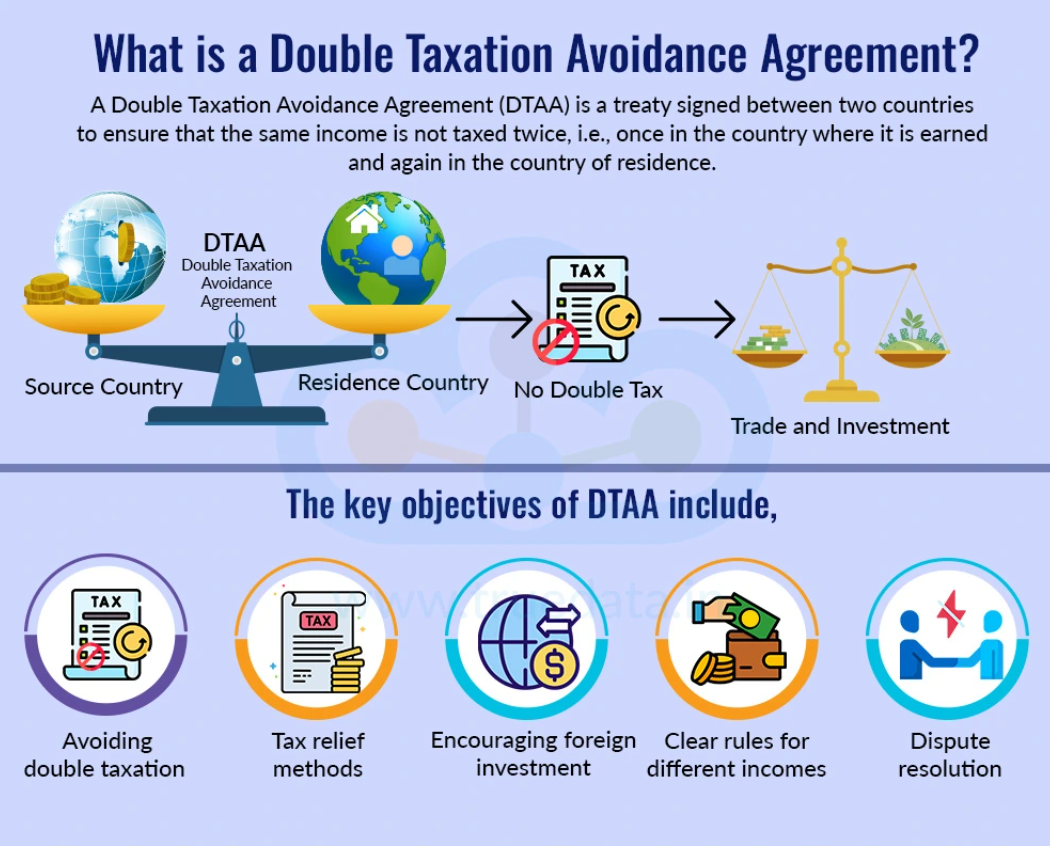
What is the difference between economic and juridical double taxation?
Juridical double taxation occurs when the same taxpayer is taxed by two different jurisdictions on the same income, typically a company taxed in both its country of residence and the country where income is earned. Economic double taxation occurs when the same income is taxed twice in the hands of different taxpayers, such as a C Corporation paying corporate tax.
Double taxation quietly erodes business returns more than any other single tax factor. The same dollar of income can be taxed by a corporation, again by a shareholder, again by a source country, and yet again by a residence country before reaching the person who earned it.
Legal mechanisms exist to eliminate or reduce each of these layers, but the techniques require understanding which type of double taxation applies and which relief mechanism matches each situation.
Both domestic economic double taxation - where C Corporation profits get taxed at the entity level and again as shareholder dividends - and international juridical double taxation, in which the same income gets taxed by two countries, appear in this guide.
Legal structures, treaty provisions, elections and foreign tax credit mechanisms that reduce the overall tax burden without crossing into evasion are discussed throughout. Current US Internal Revenue Code provisions, OECD Model Tax Convention principles and the practical framework of modern substance-based international tax planning inform all analysis.
The Two Types of Double Taxation
Tax literature distinguishes two categories, and the distinction matters because the tools for each are different.
Economic Double Taxation. The same income is taxed in the hands of two different taxpayers. The classic example is the C Corporation. The Corporation earns profits and pays 21 percent federal corporate tax (plus state corporate tax). It distributes after-tax profits as dividends.
The shareholder pays another round of tax on the dividend at qualified dividend rates (0, 15, or 20 percent) plus the 3.8 percent net investment income tax. The combined effective rate on distributed earnings can exceed 40 percent.
Juridical Double Taxation. The same income is taxed by two different jurisdictions in the hands of the same taxpayer. The classic example is a company resident in one country earning income in another country. Both countries claim taxing rights under their domestic law, and without relief mechanisms, the income is taxed twice at full rates.
The economic versus juridical distinction determines which tools apply. Structural choices (S Corporation election, LLC pass-through, partnership form) address economic double taxation. Treaty-based relief (reduced withholding, foreign tax credits, exemption methods) addresses juridical double taxation.
Founders sometimes try to use an S election to solve a cross-border problem, which does not work, or try to use a treaty to solve a C Corp dividend problem, which also does not work.
Eliminating Economic Double Taxation
The simplest solution to economic double taxation is to use a pass-through entity from the start. LLCs taxed as partnerships, S Corporations and sole proprietorships all avoid entity-level taxation by pushing income directly to owners. The structural choice is covered in detail in the Corpy guide on LLC versus Corporation.
S Corporation Election
A domestic eligible Corporation can elect S Corporation status by filing Form 2553 within 2 months and 15 days of the tax year in which the election is to take effect. The election eliminates entity-level federal income tax. Shareholders receive K-1 statements and pay tax on their pro rata share of Corporation income at their personal rates.
S Corporation election is available to Corporations meeting strict eligibility rules: 100 or fewer shareholders, all individuals who are US citizens or residents, estates, or certain trusts (no Corporations, partnerships, or foreign persons), one class of stock and domestic incorporation. Violation of any requirement terminates the election.
S Corporations allow owners to receive reasonable salary plus distributions. The salary is subject to payroll taxes (Social Security, Medicare, FUTA) but distributions beyond salary flow through free of self-employment tax. This structure is particularly valuable for owner-operated businesses with consistent profits.
LLC Pass-Through
An LLC with multiple members is taxed as a partnership by default. Income, deductions, gains, losses and credits flow through to members via Schedule K-1. The LLC files Form 1065 (an informational return) but pays no entity-level federal income tax.
Single-member LLCs are “disregarded entities” by default, meaning the IRS treats the LLC as part of the owner for tax purposes. The income appears directly on the owner’s Schedule C (if a trade or business) or Schedule E (if rental or investment property).
LLC structure is broader than S Corporation because it accepts any type of owner: individuals, Corporations, trusts, partnerships, nonresident aliens and foreign entities. LLCs can also elect C Corporation or S Corporation taxation if that produces better results.
Dividend Reduction Strategies Within C Corps
Founders who must operate as C Corporations (for venture investment reasons explored in the Corpy analysis of Delaware C-Corp) can still reduce economic double taxation through:
Retained earnings rather than dividends. when profits stay invested rather than being distributed, the business pays only the 21 percent entity tax. No dividend tax kicks in until an actual distribution happens, which delays the double tax.
Reasonable compensation to owner-employees. Salary is deductible at the entity level and taxed once at the individual level. Converting distributions into salary reduces double taxation but increases payroll taxes and must be “reasonable” for the services performed.
Stock buybacks instead of dividends. Share repurchases produce capital gain at the shareholder level, potentially at long-term capital gain rates. The 2022 Inflation Reduction Act imposed a 1 percent excise tax on buybacks by public Corporations, but private Corporations are not subject to this provision.
Qualified Small Business Stock (QSBS) under Section 1202. Founders and employees can exclude up to the greater of 10 million USD or 10x basis (15 million USD or 10x basis for stock issued after 4 July 2025, with tiered 50%, 75% and 100% exclusions at 3, 4 and 5 years) from federal tax on a sale. QSBS is one of the most powerful provisions in the tax code for early-stage founders.
Eliminating Juridical Double Taxation
Cross-border income triggers juridical double taxation when both the source country (where income arises) and the residence country (where the taxpayer is based) claim taxing rights. Three relief mechanisms address this:
Tax Treaties
A double tax treaty is a bilateral agreement between two countries that allocates taxing rights and prevents the same income from being fully taxed by both. The OECD Model Tax Convention provides the template that most treaties follow.
Typical treaty provisions:
- Reduced withholding on dividends. Often 5 percent for substantial shareholdings (typically 10 to 25 percent ownership) and 15 percent for portfolio shareholdings, versus 30 percent statutory rate.
- Reduced withholding on interest. Often 10 percent or 0 percent for government and inter-company loans.
- Reduced withholding on royalties. Ranges from 0 to 15 percent.
- Permanent Establishment threshold. Business profits are taxable in the source country only if a PE exists. Without a PE, the source country gives up its taxing right.
- Mutual Agreement Procedure. A dispute resolution mechanism when the two countries apply the treaty inconsistently.
By 2024, the US maintains tax treaties with 66 countries. Major trading partners like Canada, Mexico, the UK, Germany, France, Japan, Australia and most EU member states are all covered by these treaties. Direct treaties with many Gulf and Latin American countries are missing, although business conducted via treaty intermediaries can occasionally still access treaty benefits.
| Common Treaty Rates (USA treaty network) | Dividends | Interest | Royalties |
|---|---|---|---|
| United Kingdom | 5 or 15 percent | 0 percent | 0 percent |
| Germany | 5 or 15 percent | 0 percent | 0 percent |
| Canada | 5 or 15 percent | 0 or 10 percent | 0 or 10 percent |
| Japan | 0, 5, or 10 percent | 10 percent | 0 percent |
| Singapore (no US treaty) | 30 percent statutory | 30 percent | 30 percent |
| UAE (no US treaty) | 30 percent statutory | 30 percent | 30 percent |
The absence of a US-UAE or US-Singapore tax treaty is a surprise to many founders moving operations to those jurisdictions. Structures must be designed around the absence of treaty relief, often using intermediate holding companies in treaty jurisdictions with economic substance.
Foreign Tax Credit
In systems where the residence country taxes worldwide income yet permits a credit for foreign taxes paid, the effective rate usually caps at the higher of the two rates. Americans claim the Foreign Tax Credit through IRC Sections 901 to 909, but this credit is capped by the Section 904 foreign tax credit limitation.
The limitation prevents the credit from being used against US tax on US-source income. It is calculated as: total US tax multiplied by (foreign-source taxable income divided by total taxable income). Excess foreign taxes carry back 1 year and forward 10 years.
Foreign tax credits apply to most foreign income taxes but not to foreign VAT, excise taxes, or other non-income taxes. Withholding taxes on dividends, interest and royalties generally qualify as creditable foreign income taxes under the Section 901 standards.
Exemption Method
Some countries use an exemption method instead of a credit method. Under exemption, foreign-source income is excluded entirely from the residence country’s taxable income. This is common in territorial tax systems and participation exemption regimes.
Since the Tax Cuts and Jobs Act of 2017, the US has applied a modified territorial approach to shareholders holding 10 percent or more of a foreign corporation. Under IRC Section 245A, dividends flowing from foreign subsidiaries to US C Corporation parents are generally 100 percent deductible, making them effectively tax-exempt.
The Section 245A dividends-received deduction is one of the most significant international tax provisions ever enacted in the United States. It converted the United States from a worldwide tax system for corporate shareholders to a modified territorial system in one stroke, aligning US practice with most OECD countries.
International Structuring Realities
Modern international tax planning operates under BEPS (Base Erosion and Profit Shifting) constraints, the EU Anti-Tax Avoidance Directive (ATAD), and domestic controlled foreign corporation (CFC) rules. The substance-over-form requirements mean that paper structures without real operations no longer work.
For founders evaluating cross-border operations, the comparison of major alternatives is useful. The Corpy analysis of UAE vs Singapore vs Estonia for remote business covers the treaty networks, substance requirements and effective tax rates that apply in each jurisdiction for internationally operating founders.
Controlled Foreign Corporation Rules
US shareholders owning 10 percent or more of a foreign corporation are subject to Subpart F and GILTI (Global Intangible Low-Taxed Income) rules. These provisions treat certain categories of foreign corporation income as currently taxable to the US shareholders even if not distributed.
Subpart F Income. CFCs generating passive income such as dividends, interest, rents and royalties, along with specified sales and services income, report that income to US shareholders immediately upon earning.
GILTI. Net tested income of CFCs in excess of a 10 percent return on tangible assets is included in US shareholders’ income, with a 50 percent deduction for C Corporation shareholders under Section 250 (reduced to 40 percent from 2026, when GILTI was renamed net CFC tested income under the 2025 OBBBA).
Moving operations to a zero-tax jurisdiction does not eliminate US tax on US-owned foreign corporations. It defers or cuts the rate, resulting in an effective US tax of about 10.5 percent on GILTI inclusions through 2025 (21 percent statutory after the 50 percent deduction) and approximately 12.6 percent from 2026 (40 percent deduction) instead of eliminating it completely.
EU Anti-Tax Avoidance Directive
ATAD I and ATAD II impose minimum standards across EU member states:
- General anti-abuse rule (GAAR)
- Interest limitation rule (30 percent of EBITDA cap on deductible interest)
- Exit taxation on cross-border asset transfers
- CFC rules
- Hybrid mismatch rules
- Reverse hybrid entity rules
Aggressive tax planning is contained across the EU through these rules. Mismatches between tax systems and aggressive interest stripping are no longer viable in the majority of cases.
Digital Services Taxes and Pillar Two
Multinational enterprise groups with revenue over 750 million euros face a 15 percent global minimum tax under the OECD’s Pillar Two framework. Rollout is happening across OECD member countries, with enforcement dates through 2024 to 2026.
Pillar Two adds a qualified domestic minimum top-up tax (QDMTT), an income inclusion rule (IIR), and an undertaxed profits rule (UTPR) to ensure that large multinational groups pay at least 15 percent in each jurisdiction where they operate. Small and medium businesses below the 750 million euro threshold are not affected, but the architecture signals the direction of international tax policy.
Substance Requirements
All substantial jurisdictions now demand economic substance in tax-favored structures. Economic-substance rules commonly require:
- Office space that suits the activity in terms of size is required.
- Activities require qualified employees whose numbers and skills fit precisely.
- Local decision-making authority
- Relevant expenses incurred locally
- Business records and management functions in the jurisdiction
Economic Substance Regulations took effect in the UAE in 2019 for relevant activities including banking, insurance, investment fund management, shipping, lease finance, holding companies, intellectual property, headquarters and distribution/service centers. Filing requirements consist of annual ESR notifications and substance reports from companies.
Singapore applies substance requirements through the Enhanced Tier Fund Scheme and various incentive regimes. Estonia applies beneficial ownership and substance tests for treaty and EU directive relief.
Transfer Pricing
Cross-border transactions between related entities must be priced at arm’s length under OECD Transfer Pricing Guidelines and domestic law equivalents. Transfer pricing adjustments are a major source of double taxation because one country might adjust a price upward while the other does not correspondingly adjust downward.
The relief mechanisms include:
- Mutual Agreement Procedure (MAP) under tax treaties
- Advance Pricing Agreements (APAs) are negotiated bilaterally or unilaterally before transactions take place.
- Documentation requirements for demonstrating arm’s length nature include the Master File, Local File and Country-by-Country Reporting.
Nearly all multinational groups must maintain transfer pricing documentation. Taxpayers who do not prepare contemporaneous documentation risk presumptions working against them and much larger adjustment amounts.
Practical Scenarios
Scenario 1: US C Corp with UK subsidiary
The US parent owns 100 percent of the UK subsidiary. UK profits are taxed at 25 percent in the UK. Dividends from UK to US are taxed at 0 percent UK withholding (under the US-UK treaty for 80 percent-plus ownership) and 100 percent deducted by the US parent under Section 245A. Effective worldwide rate: 25 percent. No double taxation.
Scenario 2: US individual owns UAE company
An American individual holds a UAE free zone company that earns 500,000 USD in qualifying income. UAE tax liability: 0 percent. How the US treats this situation: the UAE company qualifies as a CFC, and GILTI rules apply.
Following the 50 percent Section 250 deduction available only to C Corps and not individuals, the full income appears on the individual shareholder’s US return at individual rates. Approximate effective rate: around 37 percent (the top marginal rate). The UAE’s no-tax benefit does not accrue to US individual shareholders.
Scenario 3: UK resident owns Delaware C-Corp
The UK resident individual owns a Delaware C-Corp. The Corporation pays 21 percent US federal tax plus any state tax on profits. Dividends from the C-Corp are subject to US withholding: 15 percent under the US-UK treaty for portfolio investors. The UK recipient pays UK tax on the gross dividend (8.75 to 39.35 percent depending on income) with credit for the 15 percent US withholding.
Combined effective rate can reach 50 to 60 percent.
This scenario is why many UK founders structure US operations through a UK holding company or elect S Corp status (if eligible, though non-residents cannot). The alternative is to accept high effective rates on distributed earnings from US operations.
Specific Provisions to Know
| Provision | Jurisdiction | Purpose |
|---|---|---|
| Section 901 FTC | United States | Credit for foreign income taxes |
| Section 245A DRD | United States | 100 percent dividends-received deduction |
| Section 250 GILTI deduction | United States | 50 percent deduction on GILTI inclusion |
| Section 951A GILTI | United States | Current inclusion of CFC income |
| Section 1202 QSBS | United States | Up to 10 million USD exclusion (15 million USD for stock issued after 4 July 2025) on qualified small business stock |
| Section 83(b) election | United States | Recognize ordinary income at grant rather than vesting |
| Participation Exemption | EU member states | Exempt qualifying inter-company dividends |
| Patent Box | UK, NL, FR | Reduced rate on qualifying IP income |
| Notional Interest Deduction | Belgium | Deduction for equity-funded operations |
| Territorial System | Singapore, HK | Foreign-source income often exempt |
International Founders and Remote Operations
Certifications and Professional Support
Compliance Calendar
Timely filings across every relevant jurisdiction are required for double taxation relief. A standard US-international structure includes:
- Federal Form 1120 or 1120-S is submitted annually.
- File Form 5471 annually for foreign corporations.
- Annual Form 5472 is required for foreign-owned US disregarded entities.
- Form 1118 for foreign tax credit calculation (annual for Corporations)
- Individuals use Form 1116 to calculate foreign tax credits on an annual basis.
- Every year, Form 114 - FBAR requires reporting of foreign bank accounts over 10,000 USD.
- Specified foreign financial assets require Form 8938 to be filed annually.
- Annual country-by-country reporting (Form 8975) requirements apply to US-parented groups generating 850 million USD or more in revenue annually.
- Contemporaneous transfer pricing documentation that gets updated annually.
Non-filing penalties for these forms run from 10,000 USD per form (Forms 5471, 5472 and 8938, for instance) to substantial amounts for willful FBAR violations, where the penalty is the greater of approximately 100,000 USD or 50 percent of the account balance. Working the compliance calendar effectively requires good professional support, the cost of ignoring it is substantial.
Structural Decision Framework
The decision framework for minimizing double taxation:
Is this a single-jurisdiction business? If yes, choose a pass-through structure to eliminate economic double taxation. Only move to C Corp if institutional investment requires it.
Is this a multi-jurisdictional business? If yes, analyze the treaty network first. Choose intermediate jurisdictions that have treaties with both source and destination countries. Ensure substance in every jurisdiction.
Is this a high-growth, venture-backed business? If yes, Delaware C Corp is almost required. Use QSBS (Section 1202) as the long-term tax strategy rather than trying to eliminate current double taxation.
Is this a foreign-inbound business? Should the answer be yes, examine the treaty with the home country in detail. Weigh whether an intermediate treaty jurisdiction strengthens the outcome.
Does the structure have genuine economic substance? If no, the structure will fail under modern anti-abuse rules. Build substance or choose a simpler structure.
What is a business entity and its types for double taxation planning?
A business entity is a legal structure for conducting business activities with distinct tax treatment, liability protection and ownership flexibility. Primary types for double taxation planning: Pass-through entities (LLC, S-Corp, Partnership) where profits flow directly to owners and are taxed only once at owner level - no corporate-level tax.
Corporate entities (C-Corp) where profits are taxed at corporate level (21% federal + state in US, 25% UK, 30% to 33% Germany, 25% Turkey, 25% Canada, 17% Singapore with partial exemption reducing effective rate) and again at shareholder level when distributed as dividends - classic double taxation.
Hybrid entities: S-Corp (US, pass-through but limited to 100 US citizen/resident shareholders), LLP (UK, Ireland, Singapore - professional services partnership with liability shield), Societe en Commandite (French), KG (German limited partnership).
International double taxation planning uses tax treaties and structural optimization: Irish Ltd (12.5% corporate tax) + Dutch BV (participation exemption) + Delaware holding + US operating through cost-sharing agreements historically enabled global tax optimization, now constrained by BEPS (Base Erosion and Profit Shifting) and GloBE (Global anti-Base Erosion) 15% minimum tax rules.
Simple double taxation avoidance for solo founders: use pass-through LLC (Delaware $110 + $300/year or Wyoming $100 + $60/year) in US, Estonian OU (EUR 265 formation + 0% on retained profits) for EU operations, or Portuguese Unipessoal Lda (EUR 360 + 21% corporate tax) with dividend tax credits for resident owners.
For venture-funded C-Corps targeting acquisition exits, QSBS $10M+ capital gains exclusion after 5-year hold neutralizes much of the double taxation pain.