

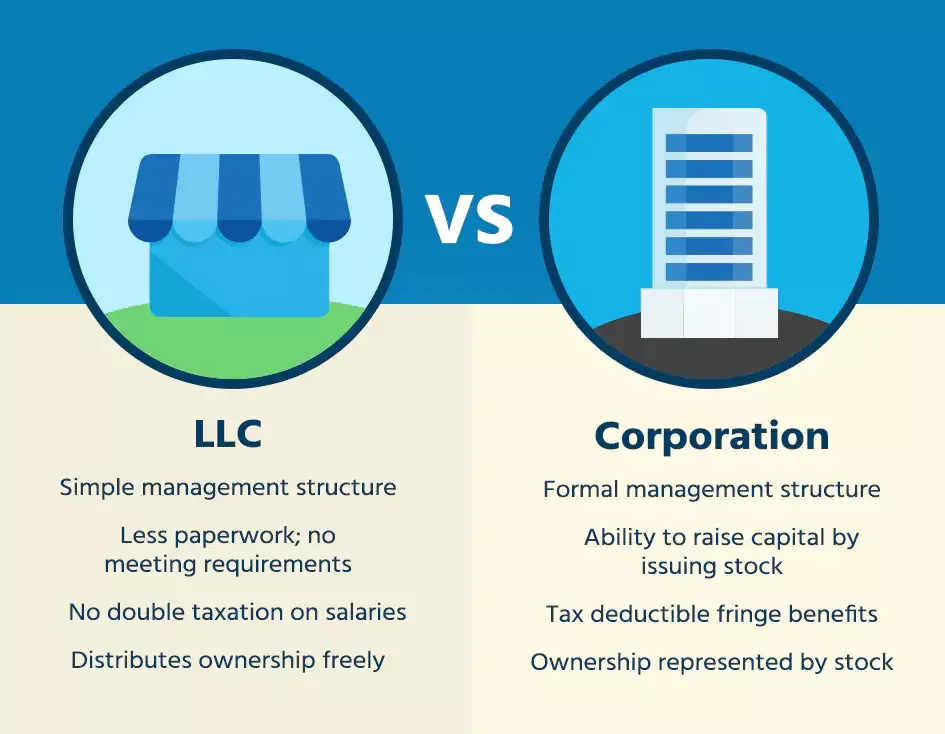
Is an LLC or a Corporation better for a small business with two owners?
For a two-owner small business with no plans to raise venture capital or issue stock to employees, an LLC taxed as a partnership is typically the cleaner choice. It gives both owners limited liability, pass-through taxation that avoids the double taxation of C Corporations, and the flexibility to split profits and losses in ways that do not have to match.
Selecting between a Limited Liability Company and a Corporation determines how founders manage taxes, financing, profit distribution and liability protection throughout a business’s lifespan. While both provide personal liability protection, they split sharply on taxation, governance, ownership flexibility and fundraising strength.
Founders get substantial savings and reduced friction by choosing correctly at launch, since the decision saves years of restructuring and tax management. Choosing incorrectly requires costly conversions, missed funding opportunities and the real risk of double taxation.
This guide compares LLCs and Corporations across every factor that matters to founders in 2026, including federal and state tax treatment, investor preferences, equity compensation mechanics, administrative load, and the signals each structure sends to banks, clients, and regulators.
The analysis reflects current Internal Revenue Service rules, Delaware General Corporation Law updates, and the Revised Uniform Limited Liability Company Act as adopted across most states.
The Fundamental Difference
State statute creates an LLC as a hybrid entity combining the liability protection of a corporation with the tax efficiency of a partnership or sole proprietorship. Corporation structure is older and more formal, featuring a defined governance pyramid of shareholders, directors and officers along with default rules that subject the entity to income tax at the corporate level.
How corporations are taxed turns on the distinction in the tax code. By default, corporations operate under Subchapter C of the Internal Revenue Code and get taxed separately, though they can elect S Corporation status under Subchapter S.
LLCs function as disregarded entities for tax purposes by default - single-member LLCs are ignored, multi-member LLCs are taxed as partnerships - but they can shift to C or S Corporation taxation by filing Form 8832 or Form 2553. Election flexibility through these forms represents the LLC’s primary strength.
The LLC was invented to solve a narrow problem: give small business owners liability protection without forcing them into the rigid governance and double-tax regime of the Corporation. What started as a Wyoming innovation in 1977 now accounts for a majority of new US business formations.
Liability Protection Basics
Both structures create a legal shield between business debts and owner personal assets. If the company is sued or defaults on a loan, creditors generally cannot pursue the owner’s home, savings, or personal property.
This shield only holds if the owner respects the entity’s separateness by maintaining separate bank accounts, signing contracts in the company’s name, adequately capitalizing the entity and following the formalities each structure requires.
Piercing the corporate veil happens when courts disregard the liability shield because the owner treated the entity as an alter ego. Courts apply similar veil-piercing doctrines to LLCs, though some states apply a slightly more forgiving standard to LLCs on the theory that LLCs were designed to reduce formalities.
Taxation Side by Side
| Tax Feature | Single-Member LLC (default) | Multi-Member LLC (default) | S Corporation | C Corporation |
|---|---|---|---|---|
| Entity-level federal tax | None | None | None | 21 percent flat |
| Pass-through to owners | Yes, on Schedule C | Yes, on Form 1065 / K-1 | Yes, on Form 1120-S / K-1 | No |
| Self-employment tax on profits | Yes, full amount | Yes, for active members | No on distributions beyond salary | No |
| Qualified dividends for owners | Not applicable | Not applicable | Not applicable | Yes, 0-20 percent |
| Ownership restrictions | None | None | 100 US individuals, one class | None |
| Foreign owners allowed | Yes | Yes | No | Yes |
| Stock classes allowed | Flexible units | Flexible units | One class | Unlimited classes |
Double taxation is the single biggest argument against C Corporation status for owner-operators who plan to distribute profits. The C Corporation pays 21 percent federal tax on profits, then shareholders pay another 0, 15, or 20 percent on dividends plus the 3.8 percent net investment income tax where applicable. Combined effective rates can exceed 40 percent on distributed earnings.
For founders who want to avoid this trap while keeping a corporate structure, the mechanics are detailed in the Corpy guide on how to avoid double taxation legally.
Pass-through entities including LLCs, S Corporations and partnerships push all income and losses to the owners’ personal returns. There is no entity-level tax, so profits are taxed once at individual rates. Owners can also claim the 20 percent Qualified Business Income deduction under Section 199A if their business qualifies and they fall within the income thresholds.
Self-Employment Tax Mechanics
The most common tax mistake made by new LLC owners is underestimating self-employment tax. An active member of a multi-member LLC pays 15.3 percent self-employment tax on the first 184,500 dollars of net earnings in 2026 and 2.9 percent Medicare tax on earnings above that, plus the additional 0.9 percent Medicare surtax on high earners. This is on top of ordinary income tax.
The S Corporation election reduces this burden. An owner-employee of an S Corporation pays payroll taxes only on the salary portion of their compensation. Distributions beyond reasonable salary flow through free of self-employment tax. This is why profitable owner-operated businesses often elect S Corporation status once profits reliably exceed 80,000 to 100,000 dollars per year.
Governance and Formalities
Corporations require a three-tier governance structure. Shareholders elect directors, directors appoint officers and officers run day-to-day operations. Even a single-shareholder Corporation must technically hold annual meetings, record minutes, adopt bylaws and pass resolutions for major actions.
LLCs have no statutorily mandated governance structure. The operating agreement is the only required internal document, and even that is not filed with the state. Members can manage the LLC directly (member-managed) or appoint managers (manager-managed). There are no required meetings, no minutes, no bylaws.
Small Corporations routinely ignore their formalities for years, only to face veil-piercing arguments when they get sued. The LLC removes that risk by design. For a business that does not need outside investors, the Corporation’s formalities are dead weight.
Document Workflow Reality
Both structures generate paperwork that founders often underestimate. Operating agreements for LLCs typically run 20 to 60 pages. Corporate formation packages include articles of incorporation, bylaws, shareholder agreements, stock certificates and initial resolutions. Getting these drafted and executed is where most founders first encounter professional formation services.
Raising Capital
Venture capital funds, angel syndicates and corporate investors almost universally prefer C Corporations organized in Delaware. Three structural reasons drive this preference:
First, VCs use preferred stock with liquidation preferences, participation rights, conversion mechanics and protective provisions. Only Corporations can issue multiple stock classes cleanly. LLCs can create tiered membership interests, but the tax drafting is painful and the documentation is three times longer.
Second, institutional investors have limited partners who cannot hold pass-through income without triggering Unrelated Business Taxable Income. UBTI filings complicate tax-exempt investor returns, so funds avoid LLC investments when possible.
Third, the Delaware General Corporation Law is the most developed corporate code in the world, and the Delaware Court of Chancery is the most sophisticated business court. Contract disputes, fiduciary duty claims, and merger litigation resolve faster and more predictably in Delaware than anywhere else.
The full case for Delaware incorporation for venture-backed startups is covered in the Corpy analysis of why startups choose the Delaware C Corp.
Equity Compensation
Corporations can issue Incentive Stock Options under Section 422 of the Internal Revenue Code. ISOs receive favorable tax treatment if the employee holds the shares long enough after exercise. LLCs cannot issue ISOs because ISOs are defined in terms of corporate stock.
Profits interests and capital interests enable LLCs to issue equity compensation. Properly structured under Revenue Procedure 93-27, profits interests can be tax-free at grant, though accounting and tax tracking requirements are considerably more complex than those surrounding stock option management.
Native Corporation support in professional equity administration platforms is standard practice, and LLC grants are treated as a specialized product within these platforms.
Cost Comparison Over Five Years
| Cost Category | Delaware LLC | Delaware C Corporation | California LLC | California C Corporation |
|---|---|---|---|---|
| Formation filing fee | 110 dollars | 89 dollars | 70 dollars plus 20 dollar statement | 100 dollars plus statement |
| Annual franchise tax | 300 dollars flat | 400 dollars minimum | 800 dollars minimum | 800 dollars minimum |
| Annual report | Not required | 50 dollars | 20 dollars statement | 25 dollars statement |
| Registered agent | 100 to 300 dollars | 100 to 300 dollars | 100 to 300 dollars | 100 to 300 dollars |
| Five-year minimum | 2,110 dollars | 2,589 dollars | 4,070 dollars | 4,125 dollars |
| Typical formation service | 300 to 500 dollars | 500 to 2,000 dollars | 300 to 500 dollars | 500 to 2,000 dollars |
Founders tend to overestimate the cost differential. Delaware charges an LLC a flat 300 dollar franchise tax compared to a 400 dollar minimum for C Corps, which scales based on authorized shares and assumed par value methods - the difference is modest.
Both LLCs and Corporations in California require an 800 dollar minimum franchise tax, meaning California founders pay the same baseline regardless of entity type.
State-Level Considerations
State corporate law varies in ways that matter to founders. Texas has no personal income tax but imposes a franchise tax (margin tax) on entities with revenue over 2.65 million dollars (no tax due threshold for 2024 and 2025 reports). Nevada has no corporate income tax but strong LLC statutes. Wyoming has the oldest LLC statute and strong charging order protections against creditors of members.
For operating businesses, the home state where the business is actually conducted is usually the right formation state. Forming in Delaware or Nevada while operating in California means registering as a foreign entity in California and paying California franchise tax anyway, eliminating any supposed savings.
The myth of the Nevada LLC for tax savings is the most persistent bad advice in small business formation. If you operate in California, you pay California tax regardless of where you form. The only structures that benefit from non-home-state formation are passive holding companies with no operating nexus in any particular state.
Ownership and Transferability
C Corporations have no limits on ownership. Shares can be held by individuals, trusts, other Corporations, LLCs, partnerships, foreign persons and nonresident aliens. Shares transfer by delivery and endorsement of share certificates or by electronic book entry, making secondary sales and estate planning straightforward.
S Corporations restrict ownership to 100 or fewer US individuals, estates and certain trusts. No partnerships, Corporations, or nonresident aliens can hold S Corporation stock. Only one class of stock is permitted, though differences in voting rights are allowed within that one class.
While LLCs permit any ownership arrangement, transferring membership interests is less standardized. Existing members must consent to transfers of membership interests, and default state rules commonly give transferees economic rights without voting rights until admitted as members.
Estate planning and divorce settlements are affected when the transferee receives the economic benefit of a membership interest without acquiring a vote.
International Founders
Foreign founders face different choices. Non-US persons cannot be S Corporation shareholders, so S election is off the table. C Corporations accept foreign owners without restriction, but a foreign-owned C Corporation filing Form 1120 has additional reporting obligations under Form 5472 and Section 6038A.
A foreign-owned single-member LLC is treated as a disregarded entity for income tax but is still required to file Form 5472 with a pro forma Form 1120 to report transactions between the foreign owner and the LLC. Failure to file Form 5472 carries a 25,000 dollar penalty per form per year.
International founders assessing the United States alongside other locations benefit from comparing setup, banking and residency requirements side by side. Corpy’s comparison of UAE versus Singapore versus Estonia for remote businesses examines three bigotries non-US founders evaluate before or instead of forming in the US.
When to Choose Each Structure
Choose an LLC when:
- You are a solo founder or small partnership not seeking venture capital
- Pass-through taxation without double tax exposure is what you want.
- Governance flexibility and reduced formalities are valued by you.
- The entity will hold appreciating assets such as real estate in its portfolio.
- You want the option to elect S or C tax treatment later
Choose an S Corporation (or LLC taxed as S Corp) when:
- You are an owner-operator with profits above 80,000 dollars annually
- You want to minimize self-employment tax on distributions
- All owners are US persons and you will not raise institutional capital
- One class of ownership works for your cap table
Choose a C Corporation when:
- You plan to raise venture capital or angel investment on preferred stock terms
- You intend to grant Incentive Stock Options to employees.
- Your company can pursue an IPO or strategic acquisition as an exit option.
- You need multiple classes of stock with differentiated economic rights
- You are foreign-owned and have no option to elect S status.
Compliance and Reporting Workloads
Annual tax filing is required for both structures. Corporations use Form 1120 for C Corps or Form 1120-S for S Corps. Multi-member LLCs file Form 1065 with K-1 forms sent to each member. Single-member LLCs report through the owner’s Schedule C in a sole-proprietor setup or Schedule E if it is a rental business.
State filings add requirements depending on where the LLC or corporation was formed and in each state where the business operates.
Record-keeping obligations are similar in substance but different in form. Corporations maintain stock ledgers, board minutes and bylaws. LLCs maintain member ledgers, the operating agreement and any amendments. Both should keep separate bank accounts, business credit cards and clear contract signatures under the entity name.
Professional Licensing Considerations
Certain professions require specific entity structures. Many states prohibit general LLCs from providing licensed professional services like law, medicine, accounting and architecture, requiring instead a Professional Limited Liability Company (PLLC) or Professional Corporation (PC).
California, for example, does not permit LLCs to practice law and requires a Professional Corporation for attorneys.
Banking and Credit
Business bank accounts are required for both structures. Banks generally accept either structure without preference for routine deposit accounts. For business credit (lines of credit, term loans, SBA loans), underwriters evaluate the owner’s personal credit for the first several years because the entity has no credit history of its own.
Personal guarantees on business loans undermine the liability shield for that specific debt. A sole-proprietor LLC with a personal guarantee on a 100,000 dollar line of credit has personal liability for that line regardless of entity form. This is the most common way small business owners lose their liability protection without realizing it.
Conversion and Restructuring
Statutory conversion between LLC and Corporation forms is available in most states. Delaware permits conversions in either direction under Section 266 of the DGCL and Section 18-214 of the Delaware LLC Act. What happens taxwise depends on the conversion direction and structural details.
Section 351 allows an LLC to convert to a C Corporation tax-free if former LLC members get stock proportionate to their prior interests and gain immediate control of the Corporation. This standard approach works for conversions before Series A funding.
Financiers and auditors both prefer moving in the tax year before a financing round, as it simplifies the audit and eliminates partial-year short-period returns.
Converting a Corporation to an LLC is usually a taxable liquidation under Sections 331 and 336. The Corporation recognizes gain on distributed assets, and shareholders recognize gain on the liquidation. This one-way door is why founders who form C Corporations prematurely often live with that choice longer than they should.
Networking and Legal Support Ecosystem
Quick Decision Framework
A useful test: if you can answer yes to any of these, lean toward a C Corporation. Will you raise priced equity from institutional investors? Do you need to issue ISOs to employees? Will you have foreign investors who cannot hold S Corp stock? Do you need multiple classes of stock with different economic rights?
If you answered no to all four, the LLC is usually the better starting point. You can elect S Corp taxation later when profits justify the payroll cost. You can convert to a C Corp later when fundraising requires it. The LLC preserves optionality that a C Corporation does not.