

What is the fundamental difference between a virtual office and a registered agent?
The registered agent holds a defined legal function within companies: that person or entity is designated to receive all legal documents (service of process), governmental correspondence and official notices for the business. Most US states and numerous other jurisdictions require this statutory position by law.
New founders often encounter two separate services during company formation: a virtual office and a registered agent. The services are frequently bundled, frequently confused and occasionally sold together when only one is needed.
For a founder forming a first company or expanding internationally, understanding the distinct functions, the legal requirements behind each and the scenarios where each adds value (or does not) is important for avoiding unnecessary cost and unnecessary risk.
This guide explains the difference between virtual offices and registered agents, covers the legal role of each in major jurisdictions (US, UK, EU, UAE, Singapore), and provides a practical decision framework for international founders choosing between them, selecting a combination, or deciding when to upgrade from basic services to more substantial business address infrastructure.
The analysis reflects current state and country requirements for registered office addresses, service of process rules and recent changes like the UK’s appropriate address requirement under the Economic Crime and Corporate Transparency Act 2023 effective 4 March 2024.
Two Different Services Solving Different Problems
The Registered Agent (or Registered Office)
A registered agent is a legal role. In the United States, every corporation and LLC formed in any state must designate a registered agent (sometimes called agent for service of process, statutory agent, or resident agent). The registered agent has three core functions:
- Receiving service of process (legal papers when the company is sued)
- Receiving state correspondence (annual report notices, franchise tax notices)
- Maintaining a physical address in the state available during business hours
In the UK, the equivalent is the registered office. Every UK company must have a registered office address in the UK. From 4 March 2024, this must be an appropriate address, meaning a real location where documents can be acknowledged as received. PO Boxes are no longer acceptable.
In EU member states, similar requirements apply. Each entity must have a registered office address in the state of incorporation, and service of process is typically made to that address.
The Virtual Office
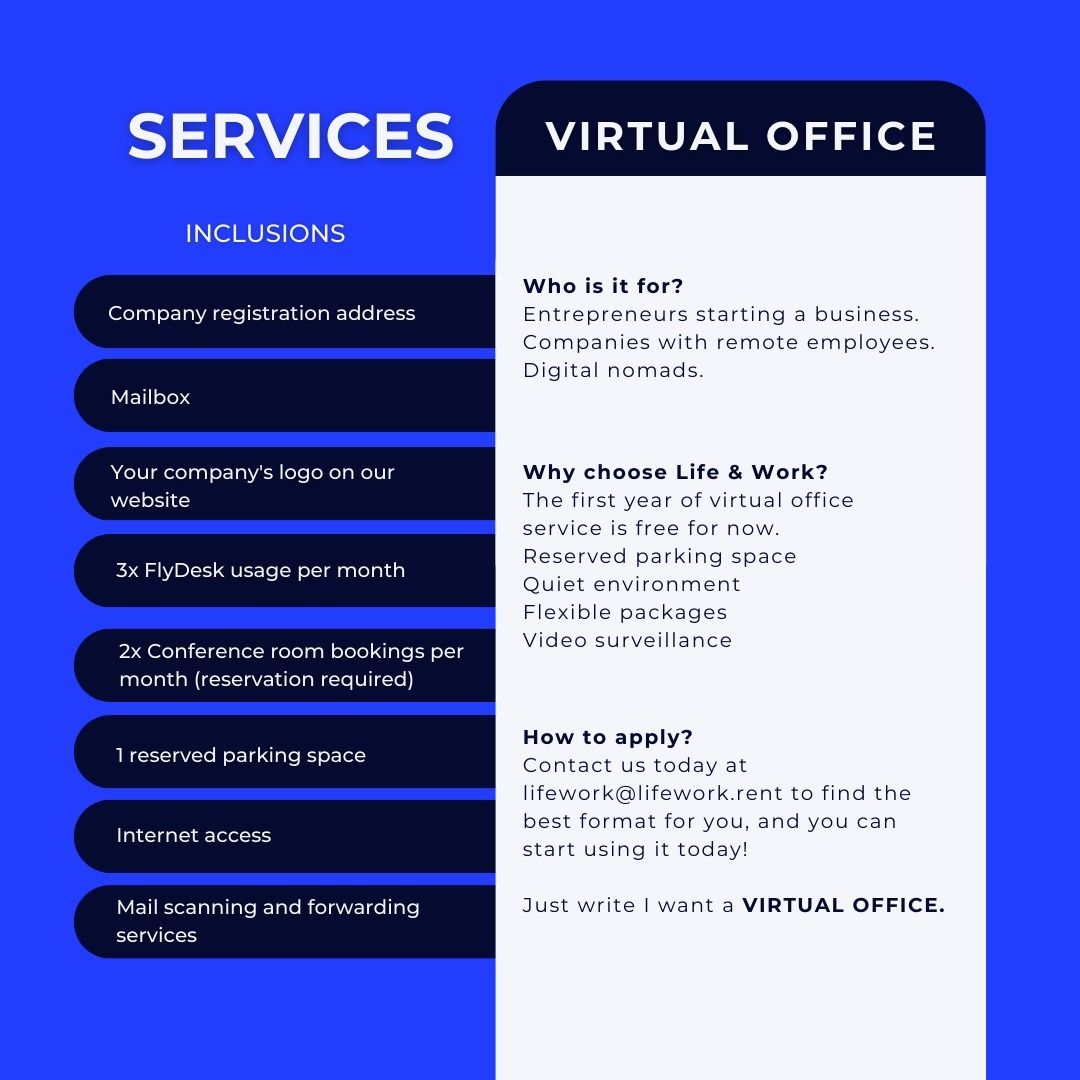
Virtual offices furnish businesses with a physical address, mail handling, phone services, meeting room access and operational infrastructure through a managed space model where the business does not maintain its own dedicated office. Standard virtual office features include:
- Professional business address required, not PO Box.
- Mail receipt, scanning and forwarding
- Phone number with dedicated answering service.
- Meeting room access on demand
- Reception services
- Sometimes registered agent/office service included
- Sometimes mail storage and handling preferences
Virtual offices are commercial products, not legal roles. A virtual office provider may also act as your registered agent, but the two functions are conceptually distinct.
Virtual office and registered agent services get mixed up regularly by founders. They purchase the costlier virtual office when the cheaper registered agent would work, or they use a minimal registered agent when their business needs a genuine business address.
This confusion wastes money and occasionally creates issues when a PO Box or mail drop cannot be used for bank accounts or regulatory requirements. Learn the difference between the two functions, then acquire only what your business requires.
Which Function Do You Need
| Function | Registered Agent | Virtual Office |
|---|---|---|
| Receive legal papers (service of process) | Yes | Not by default (unless also acting as registered agent) |
| Maintain required statutory address | Yes | If providing that function |
| Receive state correspondence | Yes | Only if acting as registered agent |
| Accept courier deliveries (FedEx, UPS, DHL) | Usually yes | Yes |
| Accept business mail | Limited (legal papers focus) | Yes (comprehensive) |
| Forward or scan mail | Sometimes | Yes (typically included) |
| Provide professional address | Usually not | Yes |
| Provide meeting rooms | No | Yes |
| Provide phone services | No | Yes |
| Bank account opening support | Limited | Usually better |
US Registered Agent Requirements by State
Universal Requirement
Every US corporation, LLC, limited partnership and similar entity must have a registered agent in the state of formation. The registered agent must:
- Be a natural person resident in the state, or a business entity authorized to provide registered agent services in the state
- Maintain a physical street address in the state (not a PO Box)
- Be available during normal business hours to accept service of process
State-by-State Specifics
| State | Registered Agent Fee (Budget) | Registered Agent Fee (Premium) | Annual Fee Required |
|---|---|---|---|
| Delaware | 50 to 100 USD | 200 to 500 USD | Yes, plus franchise tax |
| Wyoming | 25 to 75 USD | 150 to 250 USD | Yes, plus annual report |
| Nevada | 100 to 150 USD | 200 to 400 USD | Yes, plus list of managers |
| California | 100 to 200 USD | 250 to 500 USD | Yes, plus franchise tax |
| Texas | 50 to 150 USD | 200 to 400 USD | Yes, plus franchise tax |
| Florida | 50 to 150 USD | 200 to 400 USD | Yes, plus annual report |
| New York | 100 to 200 USD | 250 to 500 USD | Yes, plus biennial statement |
For detailed state-specific LLC analysis, see the Corpy guide on Delaware vs Wyoming vs Nevada LLC comparison.
What Budget vs Premium Provides
Budget services (25 to 100 USD per year):
- Receive and forward (or scan) service of process
- Receive and forward state correspondence
- Minimal documentation support
- Generic phone/online interface
- Slower processing of received documents
Premium services (200 to 500 USD per year):
- Immediate scanning and emailing of received documents
- Compliance calendar reminders
- Annual report filing assistance
- Franchise tax filing assistance
- Business license reminders
- Phone answering with business name
- Access to business compliance resources
- Document storage
For most small businesses, mid-tier services (100 to 200 USD) offer the best balance of cost and functionality.
UK Registered Office Requirements
The Appropriate Address Rule
Under the Economic Crime and Corporate Transparency Act 2023, effective 4 March 2024, the UK registered office address must be an appropriate address, defined as a location where:
- Documents delivered to the address can be acknowledged as received
- The company can be contacted
PO Boxes and addresses where the person at the address would not realistically acknowledge receipt are no longer acceptable. The address must be in the UK (England, Wales, Scotland, or Northern Ireland, depending on the jurisdiction of incorporation).
Options for UK Registered Office
- Director’s home address. Legal, but becomes public via Companies House and creates privacy issues
- Company’s trading premises. Ideal if the company has dedicated office space
- Corporate services provider. Professional registered office service (typical cost 100 to 400 GBP per year)
- Accountant or solicitor’s office. Sometimes offered as part of professional services arrangement
Separate Service Address for Directors
Directors have the option to use a separate service address for Companies House filings that differs from the registered office. Personal information can go through the service address, while the registered office handles corporate matters for the company.
Details on UK versus Ireland company formation can be found in the Corpy guide for wider UK company establishment
EU Member State Requirements
Germany
German GmbHs must have a registered office (Sitz) specified in the articles of association. The Sitz must be in Germany. Many small GmbHs use virtual office addresses provided by specialized services, typically costing 150 to 500 EUR per year. The address must be real and capable of receiving mail, similar to the UK’s appropriate address rule.
Ireland
Irish Ltds must have a registered office in the Republic of Ireland. This is a real address where documents can be served. Corporate services providers typically offer registered office services for 500 to 1,500 EUR per year.
Netherlands
Every Dutch BV requires a registered office inside the Netherlands. That address gets listed in the Dutch Chamber of Commerce (Kamer van Koophandel) database. Virtual office services providing a registered address are widely available, charging 300 to 1,200 EUR annually.
France
Every French SAS and SARL requires a registered office (siege social) inside France. Virtual office services, comparable to what other EU countries offer, cost approximately 400 to 1,500 EUR per year.
Estonia
Every Estonian OU needs a registered office inside Estonia. Companies with non-resident management under Estonian law must also appoint a contact person in the country, a service virtual offices provide for 20 to 100 EUR monthly. Business owners developing Estonian-specific strategy should consult the Corpy guide on opening a business bank account in Estonia.
UAE Requirements
UAE free zones require a physical office within the free zone or an approved flex desk/virtual office arrangement provided by the free zone authority. The specific requirements vary:
- IFZA, SHAMS and similar lighter free zones. offer flex desk options priced at 6,000 to 15,000 USD annually.
- DMCC, DIFC, ADGM. Desk options span from flex desk to dedicated office across these ranges.
- Mainland UAE. Requires physical office, minimum Ejari tenancy contract
For detailed UAE free zone analysis, see the Corpy guides on ADGM vs DIFC and best free zones for e-commerce businesses.
Singapore Requirements
Every Singapore company must have a registered office address in Singapore that is open and accessible to the public for at least 3 hours each business day. The address must be a physical location, not a PO Box. Corporate services providers offer registered office services starting at approximately 500 to 1,500 SGD per year.
Virtual Office Cost Structure
Virtual office pricing varies widely based on location and service level:
| Service Tier | Typical Monthly Cost | Features |
|---|---|---|
| Basic (mail address only) | 30 to 80 USD | Address, mail receipt, scanning |
| Standard | 80 to 200 USD | Address, mail forwarding, occasional meeting room |
| Premium | 200 to 500 USD | Prestigious address, full mail handling, meeting rooms, phone answering |
| Enterprise | 500+ USD | Dedicated receptionist, premium location, extensive services |
Pricing hinges on location. Virtual offices in Manhattan or central London cost substantially more than those in suburban or smaller cities. Class A building addresses improve how banks perceive a company compared to locations in generic business parks.
Decision Framework
Scenario 1: Small US LLC, Owner Resident in the State
A single-member Texas LLC operated by a Texas resident from home.
Recommended. Registered agent only. The owner can use their home address as the company’s business address, or use a separate mail service for business mail. Virtual office is unnecessary unless the owner wants a commercial address for branding reasons.
Cost: 50 to 150 USD per year (registered agent).
Scenario 2: Delaware LLC Owned by Non-Resident
A Delaware LLC owned by someone living in another state or country.
Recommended. Registered agent service (required by Delaware law). Optional virtual office if the business needs a Delaware address for mail receipt beyond legal papers. Many founders use a registered agent only for Delaware and a separate business address in their actual operating location.
Cost: 100 to 250 USD per year (registered agent), plus optional virtual office 50 to 150 USD per month if needed.
Scenario 3: Foreign Founder Forming US LLC for Payment Processing
A founder outside the US forms a US LLC primarily to access Stripe, US banking, or the US market.
Recommended. Registered agent service for the state of formation, plus a US mail forwarding service or basic virtual office to receive bank correspondence, IRS notices and customer mail. Consider Wyoming or Delaware for formation (low cost and minimal state-level business presence requirement).
Cost: 100 to 250 USD per year (registered agent), plus 30 to 100 USD per month (mail forwarding or basic virtual office).
Scenario 4: UK Ltd Formed for Business Legitimacy
Founders establish a UK Ltd to gain business credibility, professional services standing or EU customer trust, while running operations from elsewhere.
Recommended. Packages registered office service with either a virtual office or mail forwarding to manage all business correspondence. The UK requires an appropriate address that can acknowledge receipt under its rules, so mail drops cost-effective though they are are not sufficient.
Cost: 100 to 400 GBP per year (registered office service), plus 50 to 200 GBP per month (virtual office) if needed.
Scenario 5: Growing Service Business
A founder has grown to 5 to 10 employees and is still working from coworking spaces or home.
Recommended. Move to premium virtual office or dedicated office space. Customers, investors and potential hires perceive a professional address as a sign of maturity. Meeting rooms become essential for hosting client sessions. Answering calls professionally strengthens that image.
Cost: 200 to 1,000 USD per month for premium virtual office, or 1,000 to 5,000 USD per month for dedicated office.
Scenario 6: International Expansion
A founder based in the US sets up a UK subsidiary to gain market presence in Europe.
Recommended. UK registered office service combined with UK virtual office for mail handling. Do not use the US founder’s personal address (fails the appropriate address rule and creates substance issues). Consider whether a UK director needed for any specific regulatory or banking reason.
Cost. Registration comes to 200 to 500 GBP annually for a registered office plus 50 to 200 GBP monthly for a virtual office.
Banking and Virtual Offices
Virtual office address acceptance from banks has hardened since 2020. Major banks now require proof of legitimate business activity extending beyond the virtual address. Strategies that work include:
- Use premium virtual office providers with real reception and mail handling
- Supplement with utility bills, lease copies, or other address verification
- Demonstrate business activity (website, contracts, revenue)
- Apply to banks known to be more flexible with virtual offices (typically digital business banks)
Digital business banks (Wise Business, Mercury, Revolut Business, Tide, Starling, Monzo Business) are generally more accepting of virtual office addresses, particularly for early-stage and digital-native businesses.
Common Mistakes
Using a PO Box where not allowed. Most US states require a street address for registered agent, most foreign jurisdictions require real addresses. PO Boxes fail multiple legal and practical tests.
Using the founder’s home address for privacy-sensitive reasons. Home addresses become publicly searchable in most US states and UK Companies House. Privacy, physical security and personal safety concerns argue for using a third-party address.
Assuming registered agent includes mail handling: Registered agents receive legal papers and state correspondence. They do not typically handle business mail, marketing mail, or bank statements. For business mail, a virtual office or mail forwarding service is needed.
Using the cheapest registered agent. Budget registered agents may delay forwarding of received documents, miss documents entirely, or provide poor service when you need responsiveness. The savings of 50 USD per year can evaporate if a missed forward causes a default judgment or missed compliance deadline.
Confusing registered office with economic substance. A virtual office satisfies the registered address requirement but does not satisfy economic substance requirements. For substance (required in UAE free zones, Ireland for treaty benefits, Netherlands and increasingly elsewhere), real operations in the jurisdiction are needed.
Not updating addresses after moving. Registered agents, virtual office providers and Companies House/state records often lag behind when founders move personal or business addresses. Notices and compliance can falter from these missed updates.
When it comes to registered agents and virtual offices, follow this basic guidance: work with a reputable provider that runs real business operations, report address changes to them promptly whenever they occur, and review your registered agent service annually to verify documents are indeed being forwarded.
Many registered agent services fail without fanfare, with materials sitting unforwarded in the agent’s office for weeks and the business owner remaining unaware. Call the agent sporadically to confirm they remain active and forwarding documents correctly.
Service Provider Evaluation Criteria
When evaluating registered agent or virtual office providers, consider:
- Reputation and track record. Reviews, duration in business and standing within the industry matter.
- Responsiveness. How quickly documents get forwarded matters here.
- Technology. Online dashboard, mail scanning quality and notification systems.
- Compliance support. includes annual report reminders and filing assistance.
- Pricing transparency. The total cost including all add-ons is made clear.
- Coverage. Multi-state or multi-country coverage is available for businesses operating across multiple jurisdictions.
- Customer support. How responsive and skilled the support team is when issues occur.
Major US Registered Agent Providers
- Harvard Business Services. Focused on Delaware with a lengthy track record.
- Northwest Registered Agent. provides multi-state coverage with strong privacy focus.
- CT Corporation. Built for enterprise use, higher cost and favored by large companies.
- Wolters Kluwer (CT). This company shares a similar enterprise profile.
- IncFile / Bizee. Budget option
- Wyoming Registered Agent Services. Wyoming-focused
- Zenbusiness. Bundled with formation services
UK Registered Office Providers
- 1st Formations. These packages include formation and a registered office together.
- The Accountancy Partnership. Registered office bundled with accounting
- Hoxton Capital: Prestigious London addresses
- Your Company Formations. Budget option
- Central Working and similar coworking providers. They offer a virtual office with a registered address.
Cross-Cutting Considerations
The decision about registered agent and virtual office interacts with other compliance questions. Beneficial ownership reporting often requires the registered address. Tax residency and permanent establishment analysis considers where business activities occur. Banking relationships scrutinize the address.
For the broader beneficial ownership picture, see the Corpy guide on beneficial ownership reporting requirements. For the compliance calendar that interacts with registered agent notifications, see compliance calendar for international founders.
Related Corpy Resources
- Delaware vs Wyoming vs Nevada LLC comparison for state-specific registered agent decisions
- UK vs Ireland company formation for UK registered office requirements
- Best countries to incorporate for SaaS startups for jurisdiction-specific formation considerations
- Compliance calendar for international founders for deadline management
- Holding company structure explained with examples for multi-entity address management
How to dissolve a company in New York state?
New York LLC dissolution requires filing Articles of Dissolution with the NY Department of State for $60, preceded by obtaining consent from the NY Department of Taxation and Finance (tax clearance) which takes 6 to 12 weeks. For NY C-Corps, the filing is a Certificate of Dissolution ($60) plus the same tax clearance plus the IRS final Form 1120.
Steps: settle all NY state taxes and sales tax, file final NY state returns, obtain Tax Department consent, for NY LLCs, publication is required only at formation (LLC Law 206), not at dissolution; Articles of Dissolution filing is $60, file Articles of Dissolution, and close accounts. Total timeline: 4 to 8 months.
NY’s publication requirement makes dissolution uniquely expensive - Manhattan publication alone can hit $2,000. Compared to Delaware LLC cancellation at $200 and 1 to 4 weeks, NY is 5 to 10 times more expensive and slower, which is why non-NY business is typically routed through Delaware LLCs instead.
How to find a registered agent for a New Jersey LLC?
Finding a New Jersey LLC registered agent involves choosing between commercial agent services and self-service if you reside in NJ. Commercial options: Northwest Registered Agent ($125/year with free mail forwarding), Harvard Business Services ($50/year, basic service), Registered Agents Inc ($100/year), InCorp ($129/year), and ZenBusiness ($99/year bundled with formation).
NJ LLC formation itself costs $125 through the Division of Revenue, plus a mandatory $75 annual report. Virtual office providers like Regus and Davinci provide NJ addresses for $50 to $200/month but are not licensed registered agents in NJ. The agent must be a NJ resident individual or a business authorized to transact in NJ with a physical NJ address (PO boxes not acceptable).
Change of agent in NJ requires a Change of Registered Agent filing for $25 online. For non-resident founders choosing between NJ ($125 formation + $75 annual) and Delaware ($110 + $300) or Wyoming ($100 + $60), Wyoming wins on cost and privacy.
Should I use a registered agent address for my LLC?
Using a registered agent address for your LLC is appropriate for legal service of process (the agent’s statutory role) but not appropriate as your LLC’s principal business address for most purposes.
Your Certificate of Formation or Articles of Organization designates the registered agent’s address as the entity’s legal service address - this is required by every US state (Delaware, Wyoming, California, Texas, Florida and all others).
However, your LLC also has a principal business address used for IRS Form SS-4 EIN application, business bank account opening (Mercury, Relay, Chase, Bank of America all require real business addresses, not just registered agent), Stripe and payment processor KYC, commercial leases, customer-facing contact information and federal tax returns (Form 1065, Form 1120, Form 5472).
Using the registered agent address as your principal business address commonly causes banking rejections (banks flag registered agent addresses from Northwest, Harvard Business Services, etc.), Stripe underwriting friction and IRS verification delays.
Virtual office alternatives: Alliance Virtual Offices ($49 to $149/month), Davinci Virtual ($40 to $150/month), Regus ($100 to $300/month) provide dedicated business addresses with mail forwarding, phone answering and occasional meeting room access.
For international founders of US LLCs, a US virtual office ($15 to $50/month basic mail-forwarding services like Anytime Mailbox, Earth Class Mail) provides compliant business address separate from registered agent address. Never use PO Box as principal address - IRS and most banks reject PO Boxes for KYC.