

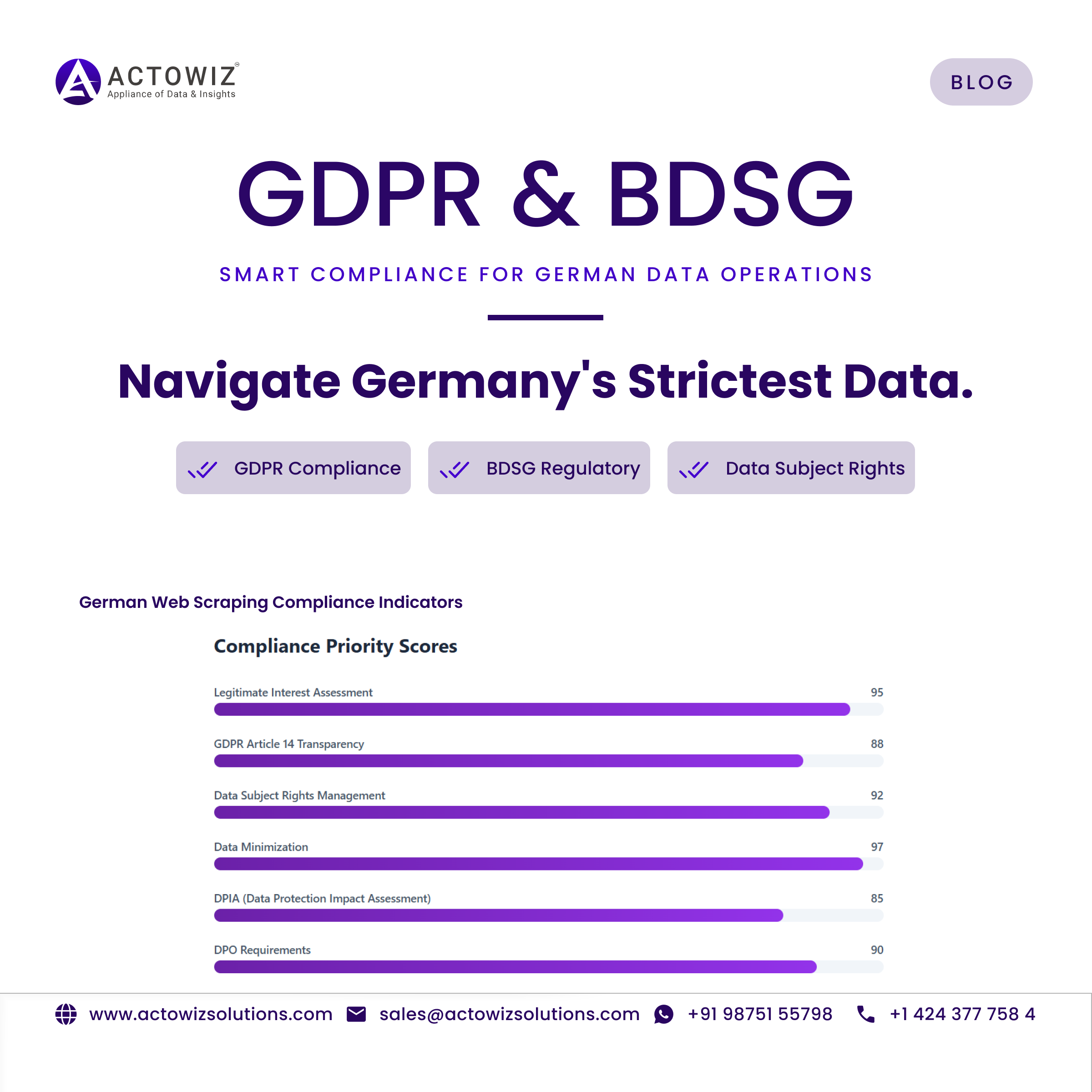
Does a business in Germany need a Data Protection Officer (DPO)?
Under German law (BDSG Section 38), a business must appoint a Data Protection Officer if it regularly employs 20 or more persons engaged in the automated processing of personal data. This threshold is stricter than the general EU GDPR requirement.
Germany has one of the most rigorous data protection enforcement environments in the European Union. While the General Data Protection Regulation (GDPR) applies uniformly across all EU member states, Germany supplements it with the Bundesdatenschutzgesetz (BDSG), which introduces additional requirements that go beyond the GDPR baseline.
For businesses operating in Germany, compliance with both frameworks is mandatory, and the consequences of non-compliance include substantial fines, operational disruptions, and reputational damage.
This guide provides a practical, step-by-step approach to achieving and maintaining GDPR compliance for businesses in Germany as of 2026. It covers the interplay between the GDPR and BDSG, Data Protection Officer requirements, consent management, data processing agreements, enforcement and fines, and a structured compliance implementation roadmap.
For broader business compliance obligations in Germany, see our essential compliance guide. For labor-specific data protection requirements, refer to our guide on German labor law for employers.
The German Data Protection Framework: GDPR Plus BDSG
The GDPR became directly applicable across the EU on May 25, 2018. However, the regulation contains numerous “opening clauses” that allow member states to enact supplementary national legislation. Germany has used these clauses extensively through the Bundesdatenschutzgesetz (BDSG), creating what is effectively a GDPR-plus regime.
The BDSG was completely revised in 2018 to align with the GDPR while exercising Germany’s national prerogatives. Key areas where the BDSG goes beyond the GDPR include:
- Data Protection Officer thresholds: The BDSG mandates a DPO for companies with 20 or more employees engaged in automated data processing, a significantly lower bar than the GDPR’s activity-based triggers.
- Employee data processing: BDSG Section 26 provides specific rules for processing employee personal data, supplementing the general GDPR lawful bases.
- Video surveillance: BDSG Section 4 contains specific provisions for video surveillance of publicly accessible spaces.
- Scoring and creditworthiness: BDSG Sections 31 and 37 govern automated scoring decisions and credit reporting.
Understanding the dual-layer structure of German data protection law is critical. A company that achieves “GDPR compliance” based on the regulation text alone will likely still fall short of German legal requirements. The BDSG adds obligations that do not exist in the GDPR itself, particularly regarding the DPO appointment threshold and employee data processing.
Businesses operating across multiple EU countries should not assume that their pan-European GDPR compliance program automatically satisfies German requirements without specific adjustments.
German Data Protection Authorities
Germany has a decentralized data protection enforcement structure consisting of 17 supervisory authorities:
- BfDI (Bundesbeauftragter fuer den Datenschutz und die Informationsfreiheit): The Federal Commissioner for Data Protection, responsible for federal public bodies and telecommunications/postal companies.
- 16 Landesdatenschutzbehoerden (State Data Protection Authorities): Each German state (Land) has its own independent data protection authority responsible for the private sector and state-level public bodies within its jurisdiction.
The competent authority for a private business is determined by the state where the company has its registered office. For example, a GmbH registered in Bavaria falls under the Bayerisches Landesamt fuer Datenschutzaufsicht (BayLDA) in Ansbach, while a company in Hamburg answers to the Hamburgischer Beauftragte fuer Datenschutz und Informationsfreiheit (HmbBfDI).
Key State Authorities and Notable Enforcement Actions
| State Authority | State | Notable Enforcement Focus |
|---|---|---|
| BayLDA (Bayerisches Landesamt fuer Datenschutzaufsicht) | Bavaria | International data transfers, cookie consent |
| LfDI Baden-Wuerttemberg | Baden-Wuerttemberg | Employee data processing, cookie consent |
| BfDI (Federal) | Federal | Telecommunications, federal agencies |
| HmbBfDI | Hamburg | EUR 35.3M H&M fine (employee surveillance) |
| BlnBDI (Berliner Beauftragte fuer Datenschutz) | Berlin | EUR 14.5M Deutsche Wohnen fine |
| LDI NRW | North Rhine-Westphalia | Small business compliance, marketing consent |
The decentralized enforcement structure means that companies operating across multiple German states may interact with different authorities depending on the issue. However, the primary competent authority is always determined by the location of the company’s main establishment.
The Conference of Independent Federal and State Data Protection Supervisory Authorities (DSK) coordinates enforcement approaches across all 17 authorities, though interpretive differences occasionally arise between states.
Data Protection Officer (DPO) Requirements
When a DPO Is Mandatory
Under BDSG Section 38, a business must appoint a Data Protection Officer (Datenschutzbeauftragter) if any of the following conditions apply:
The company regularly employs 20 or more persons engaged in the automated processing of personal data. This includes full-time employees, part-time employees (counted as full persons, not FTE), temporary workers, and freelancers who regularly process personal data using the company’s IT systems.
The company carries out processing that requires a Data Protection Impact Assessment (DPIA) under GDPR Article 35. This typically applies to large-scale processing of special categories of data, systematic monitoring of publicly accessible areas, or automated decision-making with legal effects.
The company’s core activity involves large-scale processing of special categories of data (health data, biometric data, genetic data, data concerning criminal convictions) or large-scale systematic monitoring of data subjects.
Internal vs. External DPO
The DPO can be an employee of the company (internal DPO) or an external service provider (external DPO). Each option has distinct advantages:
| Factor | Internal DPO | External DPO |
|---|---|---|
| Cost | Salary + training costs (EUR 60,000-90,000/year) | Service fee (EUR 3,000-15,000/year for SMEs) |
| Dismissal protection | Special protection against dismissal under BDSG Section 38(2) and GDPR Article 38(3) | No employment law complications |
| Company knowledge | Deep understanding of internal processes | Requires onboarding and ongoing communication |
| Independence | Must be organizationally independent, cannot hold conflicting roles (e.g., IT manager, HR director, managing director) | Independence is inherent in the external arrangement |
| Availability | On-site availability | Availability depends on contract terms |
| Liability | Limited personal liability | Professional liability insurance typically included |
For small and medium-sized businesses in Germany, appointing an external DPO is often the most practical and cost-effective solution. An external DPO brings specialized expertise, avoids the complications of enhanced dismissal protection for an internal appointment, and eliminates potential conflicts of interest.
The DPO appointment must be communicated to the competent Landesdatenschutzbehoerde, and the DPO’s contact details must be published (typically on the company’s website privacy policy and in the data protection information provided to data subjects).
DPO Responsibilities
The DPO’s tasks under GDPR Article 39 include informing and advising the company on its data protection obligations, monitoring compliance with the GDPR, BDSG, and other data protection provisions, advising on Data Protection Impact Assessments, cooperating with the supervisory authority, and serving as the contact point for the authority.
The DPO must have expert knowledge of data protection law and practices, and the company must provide the DPO with sufficient resources, access to data processing operations, and ongoing training.
Consent and Lawful Bases for Processing
The GDPR establishes six lawful bases for processing personal data (Article 6). For most business operations in Germany, the most commonly relied-upon bases are:
Consent (Einwilligung): Must be freely given, specific, informed, and unambiguous. German authorities interpret “freely given” strictly, particularly in the employment context, where the power imbalance between employer and employee can undermine the voluntariness of consent. Pre-ticked boxes and bundled consents are not valid.
Contract Performance (Vertragsdurchfuehrung): Processing necessary for the performance of a contract with the data subject. This covers core business operations such as order processing, delivery, invoicing, and customer service related to a specific transaction.
Legitimate Interest (Berechtigtes Interesse): Processing necessary for the legitimate interests of the controller, provided those interests are not overridden by the data subject’s rights.
German authorities require a documented balancing test for each legitimate interest claim, including a clear articulation of the interest, an assessment of the necessity of processing, and a balancing of interests against the data subject’s fundamental rights.
Legal Obligation (Rechtliche Verpflichtung): Processing required by EU or German law, such as tax record retention, anti-money laundering due diligence, or social insurance reporting.
Cookie Consent and the TTDSG
Since December 2021, the Telekommunikation-Telemedien-Datenschutz-Gesetz (TTDSG) governs cookie consent in Germany, implementing the EU ePrivacy Directive. Under TTDSG Section 25, storing or accessing information on a user’s device (cookies, tracking pixels, fingerprinting) requires prior informed consent unless the storage is strictly necessary for the requested service.
German data protection authorities have issued detailed guidance on compliant consent banners, requiring that the “reject all” option be as prominently displayed and accessible as the “accept all” option, that no cookies (other than strictly necessary ones) are set before consent is obtained, and that consent can be withdrawn as easily as it was given.
Data Processing Agreements (Auftragsverarbeitungsvertrag)
Whenever a company engages a third-party service provider that processes personal data on the company’s behalf, GDPR Article 28 requires a Data Processing Agreement (Auftragsverarbeitungsvertrag or AVV).
Common Scenarios Requiring an AVV
- Cloud hosting and infrastructure providers (AWS, Azure, Google Cloud, Hetzner)
- Payroll and HR service providers
- CRM and marketing automation platforms
- Email service providers
- IT support and managed services companies
- Analytics and advertising platforms
- External call center or customer service providers
Required AVV Content
The AVV must contain at a minimum the subject matter and duration of processing, the nature and purpose of processing, the types of personal data processed, the categories of data subjects, the processor’s obligations regarding confidentiality, technical and organizational security measures, conditions for engaging sub-processors, the processor’s obligation to assist the controller with data subject requests and data breach notifications, provisions for data return or deletion upon contract termination, and audit rights for the controller.
Many international SaaS providers offer standardized Data Processing Addenda (DPAs) that serve as the AVV. While these standardized agreements are a practical starting point, German data protection authorities have emphasized that the controller remains responsible for ensuring the AVV meets all GDPR Article 28 requirements.
Controllers should review standardized DPAs critically, particularly regarding sub-processor notification procedures, audit rights (which should not be limited to third-party audit reports), and the specificity of technical and organizational measures. A boilerplate DPA that does not adequately describe the actual processing activities may be insufficient.
International Data Transfers
Transferring personal data outside the European Economic Area (EEA) requires additional safeguards under GDPR Chapter V. Following the Schrems II decision (Case C-311⁄18), transfers to countries without an EU adequacy decision must be based on Standard Contractual Clauses (SCCs) supplemented by a Transfer Impact Assessment (TIA).
The EU-US Data Privacy Framework, adopted in July 2023, provides a mechanism for transfers to certified US companies. German data protection authorities have accepted this framework but continue to scrutinize transfers to the US and other third countries closely.
For companies using US-based cloud services (which account for the majority of enterprise SaaS), the practical steps include verifying that the US service provider is certified under the EU-US Data Privacy Framework, using the latest version of the EU Standard Contractual Clauses (June 2021 version), conducting a Transfer Impact Assessment documenting the risks of the specific transfer, and implementing supplementary measures (such as encryption in transit and at rest) where the TIA identifies residual risks.
GDPR Fines and Enforcement in Germany
Germany has been one of the most active GDPR enforcers in the EU. As of 2026, German authorities have collectively imposed hundreds of millions of euros in fines. The GDPR provides for two tiers of fines:
Tier 1 (GDPR Article 83(4)): Up to EUR 10 million or 2% of annual global turnover for violations of controller and processor obligations, DPO requirements, or certification body obligations.
Tier 2 (GDPR Article 83(5)): Up to EUR 20 million or 4% of annual global turnover for violations of data processing principles, lawful basis requirements, data subject rights, or international transfer rules.
Practical Enforcement Trends
German authorities have focused enforcement activity on several key areas:
Employee Surveillance: The Hamburg authority’s EUR 35.3 million fine against H&M in 2020 for systematic employee surveillance established a benchmark for employment data protection enforcement.
Inadequate Technical Measures: Fines have been imposed on companies with insufficient password policies, unencrypted data transmission, failure to implement access controls, and inadequate data breach response procedures.
Cookie Consent Violations: Following the TTDSG implementation, authorities have increased scrutiny of website cookie banners, with particular attention to dark patterns, pre-selected options, and the ease of withdrawing consent.
Incomplete Data Processing Agreements: Companies without proper AVVs for their data processors face enforcement action even in the absence of a data breach.
Step-by-Step GDPR Compliance Implementation
The following roadmap provides a structured approach to achieving GDPR compliance for a business operating in Germany.
Phase 1: Assessment and Documentation (Weeks 1-4)
Data Mapping: Identify all personal data processing activities, including what data is collected, why, where it is stored, who has access, and how long it is retained. Document this in a Record of Processing Activities (Verarbeitungsverzeichnis) as required by GDPR Article 30.
Legal Basis Assessment: For each processing activity, identify and document the lawful basis under GDPR Article 6 (and Article 9 for special categories of data).
Vendor Inventory: List all third-party service providers that process personal data and assess whether adequate Data Processing Agreements are in place.
Gap Analysis: Compare current practices against GDPR and BDSG requirements to identify compliance gaps.
Phase 2: Policy and Process Development (Weeks 5-8)
Privacy Policy: Draft or update the company’s external privacy policy (Datenschutzerklaerung) for the website and any customer-facing communications. The policy must include all information required by GDPR Articles 13 and 14.
Internal Data Protection Policy: Develop an internal policy covering employee responsibilities, data handling procedures, clean desk policies, and incident reporting requirements.
Data Subject Rights Procedures: Establish documented processes for responding to data subject access requests, deletion requests, data portability requests, and objections to processing within the GDPR’s one-month deadline.
Data Breach Response Plan: Create a documented incident response procedure that enables the company to notify the competent supervisory authority within 72 hours of becoming aware of a data breach, as required by GDPR Article 33.
Phase 3: Technical Implementation (Weeks 9-12)
Access Controls: Implement role-based access controls ensuring that employees can only access personal data necessary for their specific function.
Encryption: Implement encryption for personal data in transit (TLS/SSL) and at rest (disk encryption, database encryption) where appropriate.
Data Retention and Deletion: Configure systems to automatically flag or delete personal data when the retention period expires, in accordance with the data retention schedule.
Cookie Consent Platform: Implement a TTDSG-compliant consent management platform (such as Cookiebot, OneTrust, or Usercentrics) that blocks non-essential cookies until consent is obtained.
Phase 4: Ongoing Compliance (Continuous)
DPO Appointment: Appoint an internal or external DPO if required and notify the competent Landesdatenschutzbehoerde.
Employee Training: Conduct data protection awareness training for all employees, with specialized training for those in high-risk functions (HR, marketing, IT, customer service).
Regular Reviews: Schedule annual reviews of the Record of Processing Activities, privacy policies, Data Processing Agreements, and technical measures.
DPIA Process: Establish a process for identifying processing activities that require a Data Protection Impact Assessment and conducting assessments before implementing new processing.
Compliance is not a one-time project but an ongoing operational requirement. The most common cause of GDPR violations in practice is not a deliberate decision to ignore the law but rather organizational drift, where initial compliance efforts are not maintained as the business evolves, new systems are introduced, or staff turnover leads to loss of institutional knowledge.
Building data protection into operational processes, rather than treating it as a standalone legal project, is the most effective approach to sustainable compliance.
Conclusion
GDPR compliance in Germany requires more than a generic EU-wide approach. The BDSG’s additional requirements, the decentralized enforcement structure, and the proactive stance of German data protection authorities create an environment where genuine, substantive compliance is necessary.
The investment in proper data protection infrastructure, whether through an external DPO, compliance software, or legal advisory, is modest compared to the potential fines and reputational consequences of non-compliance.
For businesses establishing their presence in Germany, data protection compliance should be addressed alongside company formation and core business setup. For guidance on related topics, see our articles on company registration in Germany, business compliance, and business insurance requirements.
Related Corpy Resources
- Germany business guide for a full overview of doing business in Germany
- Business laws in Germany for related articles on this topic
- Company formation in Germany to explore adjacent considerations
- Corporate tax in Germany to explore adjacent considerations
- Free zones in Germany to explore adjacent considerations