

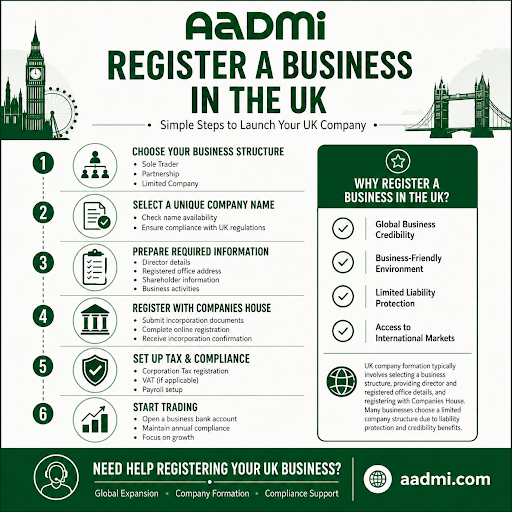
Is it better to be a sole trader or limited company in the UK?
It depends on your income level and risk tolerance. Sole trader status is simpler and cheaper to maintain, making it ideal for freelancers earning under 50,000 GBP. A limited company provides liability protection and becomes more tax-efficient above approximately 35,000 to 50,000 GBP in profit due to the ability to pay yourself through a combination of salary and dividends, reducing.
Choosing the right business structure is one of the most consequential decisions a UK entrepreneur makes. The structure you select determines your personal liability for business debts, how much tax you pay, how much administrative work is required each year, and how your business is perceived by clients, banks, and investors.
The three most common structures for small and medium businesses in the United Kingdom are the Private Limited Company (Ltd), the Limited Liability Partnership (LLP), and the Sole Trader.
Each structure has distinct advantages and disadvantages, and the best choice depends on your specific circumstances - your expected income level, the nature of your business, your appetite for administrative work, and your long-term growth plans.
This guide provides a thorough, side-by-side comparison of all three structures with current 2026 tax rates, real-world cost calculations, and clear guidance on when to choose each option.
Quick Comparison Overview
| Feature | Ltd Company | LLP | Sole Trader |
|---|---|---|---|
| Legal status | Separate legal entity | Separate legal entity | Not separate from owner |
| Liability | Limited to share value | Limited to contribution | Unlimited personal liability |
| Minimum people required | 1 director + 1 shareholder | 2 designated members | 1 person |
| Registration body | Companies House | Companies House | HMRC only |
| Registration cost | 100 GBP | 100 GBP | Free |
| Tax on profits | Corporation Tax (19-25%) | Income Tax on members (20-45%) | Income Tax (20-45%) |
| National Insurance | Employer + Employee NICs on salary | Class 2 + Class 4 NICs on profit share | Class 2 + Class 4 NICs on profit |
| Annual accounts required | Yes (filed at Companies House) | Yes (filed at Companies House) | No (Self Assessment only) |
| Public financial disclosure | Yes (accounts on public register) | Yes (accounts on public register) | No |
| Profit extraction flexibility | Salary + dividends + pension | Profit share drawings | Drawings (all profit is personal) |
| Setup complexity | Moderate | Moderate | Very simple |
The single biggest distinction between these structures is liability. A Ltd company and LLP both provide limited liability, meaning your personal assets (home, savings, personal bank accounts) are protected if the business incurs debts it cannot pay. A sole trader has no such protection - business debts are personal debts.
If your business carries any meaningful financial risk, limited liability should be your baseline requirement.
Ltd Company: Structure, Tax, and Compliance
A Private Limited Company (Ltd) is a separate legal entity from its owners. It can own assets, enter contracts, sue and be sued, and incur debts in its own name. The company is owned by shareholders and managed by directors. A single person can be both the sole director and sole shareholder.
How Ltd Company Tax Works in 2026
The Ltd company pays Corporation Tax on its profits. The 2026 rates are:
- Small profits rate: 19% on profits up to 50,000 GBP
- Main rate: 25% on profits over 250,000 GBP
- Marginal relief: Effective rate between 19% and 25% for profits between 50,000 and 250,000 GBP
After paying Corporation Tax, the remaining profits can be distributed to shareholders as dividends. Dividends are taxed at lower rates than employment income:
- Dividend allowance: 500 GBP (tax-free)
- Basic rate: 8.75% on dividends within the basic rate band
- Higher rate: 33.75% on dividends within the higher rate band
- Additional rate: 39.35% on dividends above 125,140 GBP total income
The standard tax-efficient strategy for a director-shareholder is to pay themselves a small salary (typically at the National Insurance threshold of approximately 12,570 GBP in 2026) and take the remainder as dividends. This minimizes National Insurance contributions, which are not payable on dividend income.
Worked Example: Ltd Company at 60,000 GBP Profit
| Item | Amount (GBP) |
|---|---|
| Company profit before salary | 60,000 |
| Director salary (at NI threshold) | 12,570 |
| Employer NIC on salary (13.8% above threshold) | 0 |
| Taxable company profit | 47,430 |
| Corporation Tax at 19% | 9,012 |
| Profit available for dividends | 38,418 |
| Dividend tax (8.75% after 500 GBP allowance) | 3,318 |
| Director Income Tax on salary (within personal allowance) | 0 |
| Total tax burden | 12,330 |
| Effective tax rate | 20.6% |
Annual Compliance for Ltd Companies
Ltd companies must file annual accounts with Companies House (within 9 months of the financial year end), submit a Corporation Tax return to HMRC (within 12 months), file a confirmation statement annually (50 GBP), maintain statutory registers, and hold annual general meetings if required by the articles.
Small companies qualifying for the micro-entity or small company regime can file abbreviated or filleted accounts, reducing the amount of financial information made public.
The typical annual accountancy cost for a small Ltd company is 800 to 2,500 GBP, depending on transaction volume and complexity. For a comprehensive breakdown of all costs, see our guide on the cost of starting a business in the UK.
LLP: Structure, Tax, and Compliance
A Limited Liability Partnership (LLP) is a separate legal entity that combines the limited liability of a company with the tax treatment of a partnership. Profits pass through directly to the individual members, who pay Income Tax and National Insurance on their share. The LLP itself does not pay Corporation Tax.
Key Characteristics of an LLP
An LLP requires at least two designated members (there is no upper limit). Members can be individuals or corporate bodies. There is no share capital - members contribute capital as agreed in the LLP agreement. Profits are distributed according to the LLP agreement, which can allocate different profit shares to different members.
LLPs are most commonly used by professional services firms - law firms, accountancy practices, consultancies, architects, and medical partnerships. They are less common for general trading businesses.
How LLP Tax Works in 2026
Each member is treated as self-employed for tax purposes. Their share of the LLP’s profit is subject to:
- Income Tax: 20% (basic rate, up to 50,270 GBP), 40% (higher rate, 50,271 to 125,140 GBP), 45% (additional rate, above 125,140 GBP)
- Class 2 NICs: 3.45 GBP per week (flat rate)
- Class 4 NICs: 6% on profits between 12,570 and 50,270 GBP; 2% above 50,270 GBP
There are no dividends in an LLP - all profit distributions are treated as trading income and subject to both Income Tax and NICs. This means LLP members cannot use the salary-plus-dividends strategy available to Ltd company director-shareholders.
Worked Example: LLP Member at 60,000 GBP Profit Share
| Item | Amount (GBP) |
|---|---|
| Profit share | 60,000 |
| Personal allowance | 12,570 |
| Taxable income | 47,430 |
| Income Tax (20% on first 37,700) | 7,540 |
| Income Tax (40% on remaining 9,730) | 3,892 |
| Class 2 NIC (52 weeks x 3.45) | 179 |
| Class 4 NIC (6% on 37,700) | 2,262 |
| Class 4 NIC (2% on 9,730) | 195 |
| Total tax burden | 14,068 |
| Effective tax rate | 23.4% |
At 60,000 GBP in profit, the LLP member pays approximately 1,738 GBP more in tax than the Ltd company director-shareholder. This difference widens as profits increase because dividend tax rates remain below the equivalent Income Tax rates at every band.
The LLP structure is rarely chosen for tax efficiency - it is chosen for the flexibility of profit sharing and the professional culture of partnership-based firms.
When an LLP Makes Sense
LLPs are the right choice when two or more people want to operate together with limited liability, profit-sharing flexibility is important (unequal splits, performance-based allocations), the business is in a profession where partnership structures are expected or required, or members want to avoid the dividend distribution restrictions that apply to Ltd companies (dividends can only be paid from distributable profits).
Sole Trader: Structure, Tax, and Compliance
A sole trader is the simplest business structure in the UK. There is no legal distinction between the business and the owner - they are the same legal person. All business profits belong to the individual, and all business debts are personal debts.
Setting Up as a Sole Trader
There is no registration fee. You simply register for Self Assessment with HMRC, which can be done online. You can start trading immediately. You can trade under your own name or choose a business name (but this name does not receive the same legal protection as a registered company name).
How Sole Trader Tax Works in 2026
Sole trader profits are subject to the same Income Tax and NIC rates as LLP members:
- Income Tax: 20%, 40%, and 45% at the same thresholds
- Class 2 NICs: 3.45 GBP per week
- Class 4 NICs: 6% and 2% at the same thresholds
Worked Example: Sole Trader at 60,000 GBP Profit
| Item | Amount (GBP) |
|---|---|
| Business profit | 60,000 |
| Personal allowance | 12,570 |
| Taxable income | 47,430 |
| Income Tax (20% on first 37,700) | 7,540 |
| Income Tax (40% on remaining 9,730) | 3,892 |
| Class 2 NIC (52 weeks x 3.45) | 179 |
| Class 4 NIC (6% on 37,700) | 2,262 |
| Class 4 NIC (2% on 9,730) | 195 |
| Total tax burden | 14,068 |
| Effective tax rate | 23.4% |
The tax calculation is identical to the LLP member because both are taxed as self-employed individuals. The difference is that the sole trader has unlimited personal liability.
Annual Compliance for Sole Traders
Sole traders must file a Self Assessment tax return by 31 January following the end of the tax year (5 April). There are no Companies House filings, no requirement to file public accounts, and no confirmation statement. Record-keeping requirements exist (you must keep records of income and expenses for at least 5 years) but there is no prescribed format.
The typical annual accountancy cost for a sole trader is 300 to 1,000 GBP, significantly less than for a Ltd company.
The simplicity of the sole trader structure is its greatest strength. If you are a freelancer, consultant, or small-scale trader earning under 35,000 GBP, the lower compliance costs and simpler administration often outweigh the tax savings available through a Ltd company.
However, the moment your income grows beyond this level or your business takes on risk (contracts, employees, stock, premises), the absence of limited liability becomes a serious concern.
Tax Comparison at Different Income Levels
The tax efficiency of each structure varies significantly depending on your profit level. The following table compares the total tax burden (including Income Tax, Corporation Tax, NICs, and dividend tax as applicable) at various profit levels.
| Annual Profit | Ltd Company Tax | LLP/Sole Trader Tax | Ltd Saving | Ltd Saving (%) |
|---|---|---|---|---|
| 20,000 GBP | 2,520 | 2,486 | -34 (Ltd costs more) | -0.2% |
| 30,000 GBP | 4,850 | 5,086 | 236 | 0.8% |
| 40,000 GBP | 7,230 | 7,686 | 456 | 1.1% |
| 50,000 GBP | 9,680 | 10,686 | 1,006 | 2.0% |
| 60,000 GBP | 12,330 | 14,068 | 1,738 | 2.9% |
| 80,000 GBP | 18,090 | 21,468 | 3,378 | 4.2% |
| 100,000 GBP | 24,350 | 29,268 | 4,918 | 4.9% |
| 150,000 GBP | 40,850 | 48,543 | 7,693 | 5.1% |
These figures assume a single director-shareholder using the optimal salary-plus-dividends strategy for the Ltd company. The LLP and sole trader figures are identical because both are taxed as self-employed. The Ltd figures include Corporation Tax on company profits plus dividend tax on distributions to the shareholder.
At low profit levels (under 25,000 GBP), the Ltd company’s higher compliance costs (accountant fees, confirmation statement, etc.) can negate or exceed the modest tax savings. The break-even point where Ltd becomes clearly more tax-efficient - after accounting for the higher compliance costs - is typically around 35,000 to 50,000 GBP in annual profit.
Above this level, the Ltd structure becomes progressively more advantageous.
Liability Comparison: Real-World Implications
The liability differences between these structures have practical consequences that extend beyond theoretical risk.
Sole trader liability scenario. A sole trader web developer builds a website for a client. The website has a security flaw that results in a data breach, and the client sues for 200,000 GBP in damages. The sole trader is personally liable. If they cannot pay from business funds, creditors can pursue their personal savings, home equity, and other personal assets.
Ltd company liability scenario. The same situation with a Ltd company. The company is sued, not the director personally. If the company cannot pay the damages, it may go into liquidation, but the director’s personal assets are protected (assuming no personal guarantee was given and no wrongful trading occurred).
LLP liability scenario. Similar to the Ltd company. The LLP is the entity that is sued. Individual members’ personal assets are protected, subject to the same exceptions around personal guarantees and fraudulent conduct.
When Limited Liability Can Be Pierced
Limited liability is not absolute. Directors and members can become personally liable if they:
- Continue trading when the company is insolvent (wrongful trading)
- Personally guarantee company debts (common with bank loans and leases)
- Engage in fraudulent trading
- Fail to maintain proper statutory records
- Breach their fiduciary duties as directors
Despite these exceptions, limited liability remains a powerful protection for legitimate business operations. For details on director duties and the legal framework, see our UK business laws guide.
Practical Considerations Beyond Tax
Credibility and Client Perception
Ltd companies and LLPs are generally perceived as more established and credible than sole traders. Many larger organizations, government agencies, and procurement departments have policies that require suppliers to be incorporated. Some clients may insist on working only with limited companies for their own contractual and insurance reasons.
Access to Finance
Banks and investors typically prefer lending to or investing in Ltd companies. A company has a distinct credit history, can issue shares to investors, and offers the lender the security of a corporate structure. Sole traders seeking business loans are assessed based on personal credit history, and the available loan products are often more limited and carry higher interest rates.
For guidance on setting up business banking for your chosen structure, see our UK business banking guide.
Flexibility for Growth
A Ltd company offers the most flexibility for growth. You can bring in additional shareholders, create different classes of shares, establish employee share schemes, and eventually list on a stock exchange if the business scales to that level. Sole traders who outgrow their structure must go through a conversion process, transferring assets and contracts to a new entity.
Pension Contributions
Ltd company directors can make employer pension contributions that are deductible as a business expense against Corporation Tax. This is one of the most tax-efficient ways to extract money from a company, with annual allowances of up to 60,000 GBP.
Sole traders and LLP members can also make pension contributions but claim relief through Income Tax rather than Corporation Tax, which at higher profit levels is less efficient.
Making Tax Digital (MTD)
From April 2026, Making Tax Digital for Income Tax Self Assessment (MTD for ITSA) requires sole traders and landlords with income over 50,000 GBP to keep digital records and submit quarterly updates to HMRC using compatible software. This adds administrative burden and potential software costs for sole traders that did not previously exist.
Ltd companies already file Corporation Tax returns and are not affected by MTD for ITSA.
Decision Framework: Which Structure to Choose
Choose Sole Trader If:
- You are just starting out and testing a business idea
- Your expected annual profit is under 35,000 GBP
- Your business carries minimal financial risk (no employees, no stock, no expensive contracts)
- You want the simplest possible administrative setup
- You are a freelancer or consultant with low overhead
Choose Ltd Company If:
- Your expected annual profit exceeds 35,000 to 50,000 GBP
- You need limited liability protection
- You want to optimize tax through salary-plus-dividends
- You plan to bring in investors or partners in the future
- Your clients or industry expect an incorporated entity
- You want to build a business with a separate identity and credit history
Choose LLP If:
- Two or more professionals want to practice together
- You want limited liability with partnership-style profit sharing
- Your profession traditionally uses partnership structures
- You need flexible profit allocation between members
- You want to avoid the restrictions on dividend distributions in a Ltd company
Converting Between Structures
It is possible to change your business structure as your circumstances evolve.
Sole trader to Ltd: The most common conversion. You incorporate a Ltd company and transfer the business assets, contracts, and trade to the new company. This can often be done as a tax-neutral transfer under incorporation relief. Your accountant should handle this to ensure no unintended tax liabilities arise.
Sole trader to LLP: Requires finding at least one other member. The business is transferred to the newly formed LLP.
Ltd to LLP or vice versa: More complex, involving potential tax charges on asset transfers. Professional advice is essential.
LLP to Ltd: Occasionally done when an LLP wants to bring in external investors or list publicly. Involves restructuring the membership into shareholdings.
Conversion between structures is straightforward in most cases but must be handled carefully to avoid unexpected tax charges. The timing of conversion can significantly affect the tax outcome. Consult with an accountant before converting, ideally planning the conversion to coincide with the end of a tax year or accounting period.
For step-by-step instructions on registering a Ltd company, see our guide on how to register a company in the UK.
Conclusion
The right business structure depends on your individual circumstances, and there is no universally correct answer. For most UK entrepreneurs, the decision comes down to a trade-off between simplicity (sole trader) and tax efficiency plus liability protection (Ltd company). LLPs occupy a niche that is primarily relevant to professional partnerships.
At low income levels, the sole trader structure is hard to beat - it is free to set up, simple to run, and the tax difference compared to a Ltd company is negligible or even favorable after accounting for compliance costs.
As income grows beyond the 35,000 to 50,000 GBP range, the Ltd company becomes the clear winner on tax efficiency, and the liability protection becomes increasingly valuable as the business takes on more risk.
The most important advice is to choose a structure that fits your current situation while allowing for growth. Starting as a sole trader and converting to a Ltd company when your income justifies it is a perfectly valid and common path. There is no penalty or stigma attached to converting, and the process is well-established.
For information on the UK’s corporate tax system and how it affects your choice of structure, see our UK corporate tax guide. For details on the regulatory and legal environment for all business types, consult our UK business laws guide.
Related Corpy Resources
- United Kingdom business guide for a full overview of doing business in United Kingdom
- Company formation in United Kingdom for related articles on this topic
- Corporate tax in United Kingdom to explore adjacent considerations
- Business laws in United Kingdom to explore adjacent considerations
- Free zones in United Kingdom to explore adjacent considerations