

How is end-of-service gratuity calculated in the UAE?
Under Federal Decree-Law No. 33 of 2021, employees who have completed at least one year of continuous service are entitled to end-of-service gratuity. The calculation is 21 days of basic salary for each of the first five years of service, and 30 days of basic salary for each additional year beyond five years.
Employment law in the UAE underwent a fundamental overhaul with the introduction of Federal Decree-Law No. 33 of 2021, which took effect on February 2, 2022. This legislation replaced the decades-old Federal Law No.
8 of 1980 and brought UAE labor regulations in line with modern workforce dynamics, including provisions for flexible work arrangements, enhanced anti-discrimination protections, and updated end-of-service calculations. For employers operating in the UAE - whether through a mainland company, free zone entity, or branch office - understanding these obligations is not optional.
Non-compliance carries financial penalties, work permit suspensions, and reputational damage that can undermine business operations.
This guide covers every critical aspect of UAE employment law that employers need to manage effectively in 2026, from contract structuring and wage payment obligations to gratuity calculations, leave entitlements, Emiratisation mandates, and the practical realities of dealing with the Ministry of Human Resources and Emiratisation (MOHRE).
Employment Contracts Under the New Law
The 2021 labor law introduced one of its most significant changes by mandating that all employment contracts in the UAE must be fixed-term. The previous system allowed both limited (fixed-term) and unlimited (open-ended) contracts, but all existing unlimited contracts were required to be converted to fixed-term contracts by February 1, 2023.
Fixed-Term Contract Requirements
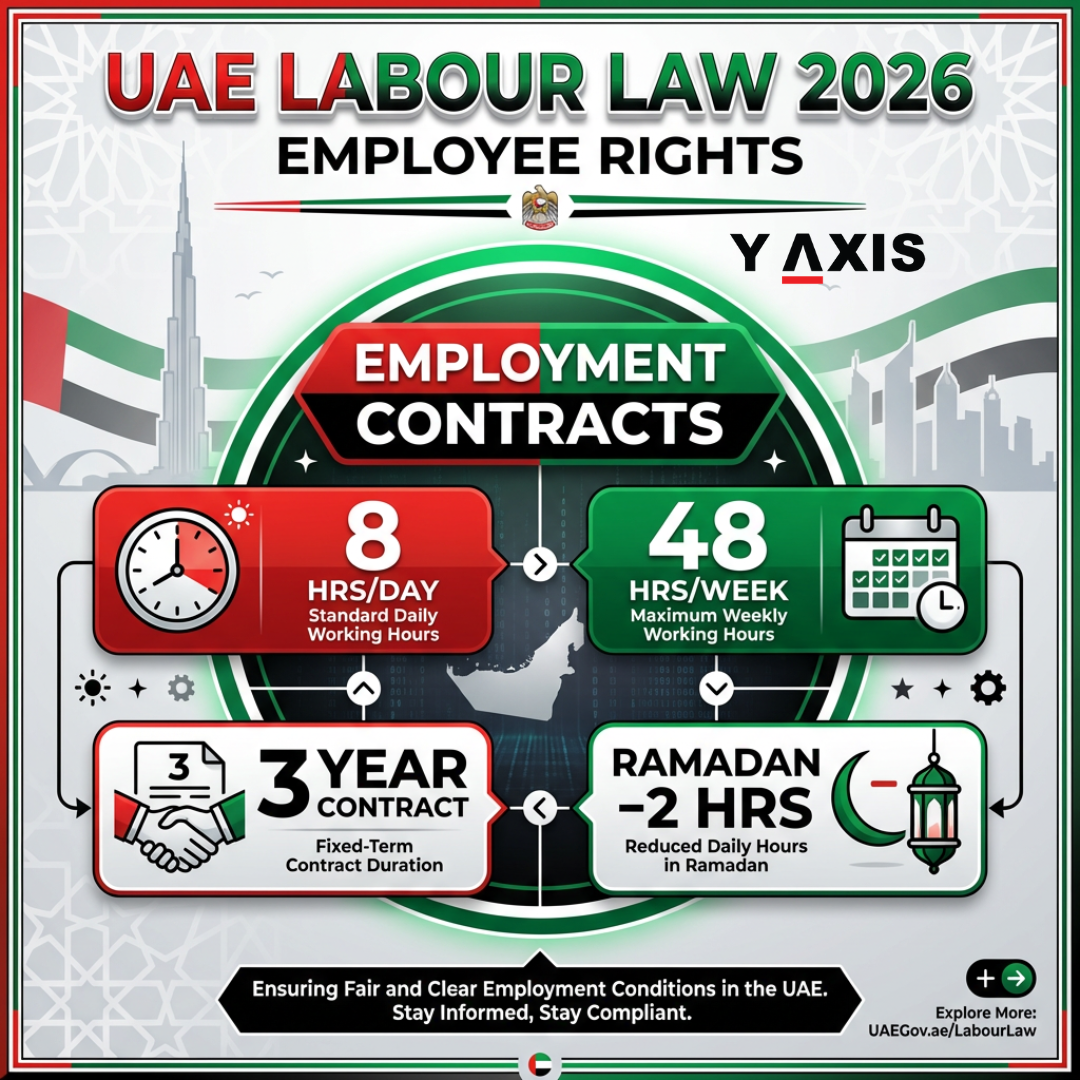
Fixed-term contracts can be issued for a maximum duration of three years and are renewable. Upon expiry, if both parties continue the employment relationship, the contract is deemed renewed on the same terms. Every employment contract must be in writing, registered with MOHRE, and include the following minimum provisions:
- Employer and employee identification details
- Start date and contract duration
- Job title and description of duties
- Place of work
- Working hours
- Remuneration (basic salary plus allowances, specified in AED)
- Leave entitlements
- Notice period for termination
- Probation period (if applicable)
The shift to mandatory fixed-term contracts caught many employers off guard. Companies that failed to convert unlimited contracts by the February 2023 deadline face administrative penalties and may encounter complications when processing visa renewals or employee terminations.
If your company still has unconverted contracts, address this immediately - MOHRE systems will flag non-compliant contracts during routine processing.
Probation Periods
Employers may include a probation period of up to six months. During probation, either party can terminate the contract with 14 days’ written notice. An employer who terminates during probation is not required to pay gratuity but must cover the employee’s repatriation costs. If the employee wishes to leave the UAE during probation, 14 days’ notice is required.
If the employee wishes to move to another UAE employer during probation, the new employer must compensate the original employer for recruitment costs unless otherwise agreed.
The Wage Protection System (WPS)
The Wage Protection System is an electronic salary transfer mechanism mandated by MOHRE that requires all private sector employers to pay employee wages through authorized financial channels. WPS was designed to eliminate late or non-payment of salaries, which was historically a significant issue in certain sectors of the UAE economy.
How WPS Works
Employers must register with an approved WPS agent (a bank, exchange house, or financial institution authorized by the Central Bank of the UAE) and transfer all employee salaries through this system. Each salary payment is recorded and monitored by MOHRE. The system captures the salary amount, payment date, and employee details, creating a transparent record that MOHRE can audit at any time.
| WPS Requirement | Detail |
|---|---|
| Registration | Mandatory for all private sector employers |
| Payment method | Through authorized bank, exchange house, or financial institution |
| Payment frequency | As per contract (typically monthly, by last day of the month) |
| Minimum delay before penalty | 15 days after the contractual due date |
| MOHRE monitoring | Automated; non-compliant companies flagged for inspection |
| Penalties for non-payment | Work permit suspension, fines, company classification downgrade |
Consequences of WPS Non-Compliance
MOHRE categorizes companies based on their WPS compliance record. Companies with consistent on-time payments receive a higher classification, which streamlines visa processing and government interactions. Companies flagged for late or non-payment face:
- Suspension of new work permit applications
- Restriction on existing employee visa renewals
- Administrative fines
- Downgrading of company classification in the MOHRE system
- Referral to law enforcement in cases of sustained non-payment
WPS compliance is one of the most scrutinized aspects of employer obligations in the UAE. Even a single month of delayed salary payments can trigger an automatic flag in MOHRE’s system, potentially disrupting your ability to process new visas or renew existing ones.
For free zone companies, while the free zone authority handles visa processing, MOHRE’s WPS monitoring still applies to employment contracts registered under federal labor law.
Working Hours, Overtime, and Rest Days
Standard Working Hours
The standard working week in the UAE is 48 hours, typically eight hours per day for six days. During the holy month of Ramadan, working hours are reduced by two hours per day for all employees, regardless of religion. Many UAE companies, particularly in the professional services and technology sectors, operate a five-day week with slightly extended daily hours.
Overtime
Any work beyond the standard eight hours per day (or the applicable reduced hours during Ramadan) constitutes overtime. Overtime compensation is calculated as follows:
| Overtime Type | Compensation Rate |
|---|---|
| Regular overtime (daytime) | Basic hourly rate + 25% |
| Night overtime (9 PM - 4 AM) | Basic hourly rate + 50% |
| Friday work (if Friday is rest day) | Basic hourly rate + 50%, or a substitute rest day |
| Public holiday work | Basic hourly rate + 50% |
Maximum overtime is two hours per day unless additional work is necessary to prevent a serious accident or mitigate its consequences. Certain categories of employees, including senior management and those in supervisory roles, may be exempt from overtime provisions if their contracts specify this.
Rest Days and Public Holidays
Employees are entitled to at least one paid rest day per week, which is typically Friday for most private sector companies. The UAE government announces public holidays annually, with the standard paid public holidays including:
- New Year’s Day (1 January)
- Eid Al Fitr (2-3 days, dates vary)
- Arafat Day (1 day, date varies)
- Eid Al Adha (3 days, dates vary)
- Islamic New Year (1 day, date varies)
- Prophet Muhammad’s Birthday (1 day, date varies)
- Commemoration Day (30 November)
- UAE National Day (2-3 December)
Annual Leave, Sick Leave, and Other Leave Types
Annual Leave
Employees are entitled to annual leave as follows:
- 30 calendar days per year after completing one year of service
- 2 calendar days per month for employees who have completed six months but less than one year of service
- No leave entitlement during the first six months (though employers may grant it at their discretion)
Unused annual leave can be carried forward or compensated in lieu upon termination. Employers cannot prevent employees from taking their annual leave for more than two consecutive years.
Sick Leave
After completing the probation period, employees are entitled to sick leave of up to 90 days per year, calculated as follows:
- First 15 days: full pay
- Next 30 days: half pay
- Remaining 45 days: no pay
An employer may terminate an employee who exhausts all 90 days of sick leave and remains unable to return to work, subject to payment of all end-of-service benefits.
Other Leave Types
The 2021 law introduced several additional leave categories:
- Maternity leave: 60 days (45 days full pay, 15 days half pay), with an additional 45 days unpaid leave if needed
- Paternity leave: 5 working days within six months of the child’s birth
- Bereavement leave: 5 days for spouse’s death, 3 days for parent, child, sibling, or grandparent
- Study leave: 10 working days per year for employees completing education at a UAE-recognized institution (after two years of service)
- National service leave: Full pay during the period of national or reserve service
The introduction of paternity leave and expanded bereavement leave were notable additions in the 2021 law. While five days of paternity leave may seem modest by global standards, it represented a significant cultural shift in the UAE’s employment framework. Employers should update their internal leave policies and HR systems to reflect all the leave categories recognized under current law.
End-of-Service Gratuity
End-of-service gratuity (also known as severance pay) is one of the most important financial obligations for UAE employers. It is calculated based on the employee’s basic salary and length of service.
Calculation Method
| Service Period | Gratuity Rate |
|---|---|
| First 5 years | 21 days of basic salary per year |
| Beyond 5 years | 30 days of basic salary per year (for each additional year) |
| Maximum total | Cannot exceed 2 years’ worth of total basic salary |
The calculation uses the employee’s most recent basic salary (excluding allowances such as housing, transport, or bonuses unless the contract specifies otherwise). For incomplete years, gratuity is calculated proportionally.
Scenarios Affecting Gratuity
Under the previous unlimited contract system, employees who resigned before completing five years received reduced gratuity. With the new fixed-term contract framework:
- Employer termination: Full gratuity entitlement for employees with one or more years of service
- Employee resignation: Full gratuity entitlement for employees with one or more years of service
- Termination for cause (Article 44): Employer may withhold gratuity entirely if the employee is dismissed for gross misconduct
- Contract expiry without renewal: Full gratuity entitlement
Gratuity must be paid within 14 days of the employment relationship ending. Failure to pay on time can result in MOHRE complaints, court orders, and administrative penalties. Employers should maintain accurate records of each employee’s basic salary history and start date to ensure correct calculations.
Common errors include using total compensation rather than basic salary, miscounting service periods, and failing to prorate for partial years.
Alternative End-of-Service Schemes
The UAE introduced a voluntary alternative to the traditional gratuity system through the Savings Scheme (also called the Alternative End-of-Service Benefits System), launched by the government in collaboration with authorized investment funds.
Under this scheme, employers can contribute monthly to a savings fund that employees can access upon termination, potentially offering higher returns than the traditional lump-sum gratuity. Participation is voluntary for both employers and employees in the private sector.
Emiratisation Requirements
Emiratisation is the UAE government’s program to increase the employment of UAE nationals (Emiratis) in the private sector. The program has become increasingly mandatory and carries substantial financial penalties for non-compliance.
Current Requirements
- Companies with 50 or more employees must increase their Emirati workforce by 2% annually
- The target is 10% Emiratisation in skilled positions by 2026
- Applies to 14 designated economic sectors including financial services, healthcare, education, retail, hospitality, technology, and real estate
- Only skilled positions (classified as levels 1-5 in MOHRE’s occupational classification) count toward the target
- Minimum salary for Emirati employees to count toward the quota is AED 4,000 per month
Penalties for Non-Compliance
| Non-Compliance Year | Monthly Fine Per Unfilled Position |
|---|---|
| 2024 | AED 6,000 |
| 2025 | AED 7,000 |
| 2026 onwards | AED 8,000 |
These fines are applied per Emirati position below the target, assessed monthly. A company with 100 employees that is 2 positions short of its Emiratisation target would face fines of AED 16,000 per month (2 positions x AED 8,000) in 2026.
Compliance Strategies
Employers can meet Emiratisation obligations through several approaches:
- Direct hiring of Emirati nationals into genuine skilled positions
- Partnering with the Nafis programme for recruitment, training, and salary support
- Participating in Emirati apprenticeship and internship programs
- Engaging with Emirati recruitment agencies and job platforms
Emiratisation is not an area where creative compliance will be tolerated. MOHRE actively monitors for “ghost Emiratisation” - where companies hire UAE nationals on paper without providing genuine employment. Companies caught engaging in sham hiring face fines of AED 100,000 per fake position, potential criminal referral, and permanent bans from government contracts.
The safest approach is genuine integration of Emirati talent supported by proper onboarding and career development.
MOHRE Registration and Compliance
The Ministry of Human Resources and Emiratisation (MOHRE) is the federal authority overseeing employment relations in the UAE’s private sector. Employers must interact with MOHRE for several critical processes.
Employer Registration
All private sector employers must register with MOHRE and obtain an establishment card. Registration requires submitting the trade license, tenancy contract, and authorized signatory details. Free zone companies interact primarily with their free zone authority for visa processing but remain subject to MOHRE’s labor law provisions.
Work Permits and Visa Processing
MOHRE issues work permits for mainland employees, which are required before the employee can obtain a residence visa from the General Directorate of Residency and Foreigners Affairs (GDRFA). The process involves labor contract approval, work permit issuance, entry permit, medical fitness test, Emirates ID enrollment, and visa stamping.
Dispute Resolution
Labor disputes are initially referred to MOHRE’s mediation department, which attempts to resolve the matter within 14 days. If mediation fails, the case is referred to the labor court. The 2021 law introduced a specialized labor court system with expedited procedures for wage claims under AED 50,000.
Practical Recommendations for Employers
Audit your existing contracts. Ensure all employment contracts have been converted to fixed-term format and comply with the 2021 law’s minimum requirements. Non-compliant contracts create liability in any termination scenario.
Automate WPS payments. Set up automatic salary disbursement through your WPS agent to ensure on-time payment every month. Manual processing introduces delays that can trigger MOHRE flags.
Maintain gratuity reserves. Calculate your total gratuity liability across all employees and ensure adequate reserves. Sudden departures of long-tenured employees can create significant unexpected cash flow requirements.
Track Emiratisation metrics. Monitor your headcount against Emiratisation targets continuously, not just at year-end. Losing an Emirati employee mid-year can push you below the target threshold immediately.
Document everything. UAE labor courts place significant weight on written documentation. Maintain signed copies of contracts, salary records, leave records, warning letters, and termination communications.
Non-Compete and Post-Employment Restrictions
The 2021 law introduced formal provisions for non-compete clauses in employment contracts. Employers can include non-compete restrictions provided they meet specific conditions:
- The restriction must be limited to a specific geographic area, duration, and type of work
- Maximum duration of the non-compete period is two years after employment ends
- The restriction must be proportionate and necessary to protect the employer’s legitimate business interests
- The non-compete must be in writing and signed by both parties
Courts will not enforce non-compete clauses that are excessively broad in scope, duration, or geographic coverage. Employers should draft these clauses carefully and ensure they are tailored to the specific role and business need.
Workplace Safety and Health
Employers have a statutory duty to maintain a safe working environment. Key obligations include providing appropriate personal protective equipment, ensuring adequate ventilation and temperature control, maintaining clean and hygienic facilities, conducting regular safety training, and reporting workplace accidents to the relevant authorities.
During summer months (June to September), outdoor work is prohibited between 12:30 PM and 3:00 PM under the Midday Break rule, with penalties for violations.
For additional guidance on setting up your business in the UAE, see our guide to starting a company in Dubai. For information on the broader regulatory environment, review our UAE business laws compliance guide. If you are considering visa options for yourself and key personnel, explore our UAE investor visa guide and UAE Golden Visa guide.
Related Corpy Resources
- UAE & Dubai business guide for a full overview of doing business in UAE & Dubai
- Business laws in UAE & Dubai for related articles on this topic
- Company formation in UAE & Dubai to explore adjacent considerations
- Corporate tax in UAE & Dubai to explore adjacent considerations
- Free zones in UAE & Dubai to explore adjacent considerations