

What is the VAT rate in the UAE?
The standard VAT rate in the UAE is 5%, introduced on 1 January 2018 under Federal Decree-Law No. 8 of 2017. This applies to most goods and services supplied in the UAE. Certain supplies are zero-rated (taxed at 0% but eligible for input tax recovery), including exports of goods and services outside the GCC, international transport, newly constructed residential properties.
Value Added Tax in the UAE is a transaction-based consumption tax that applies to most goods and services at a standard rate of 5%. Introduced on 1 January 2018 under Federal Decree-Law No. 8 of 2017, VAT has become a permanent feature of the UAE business landscape.
Unlike corporate tax, which was introduced more recently and applies only to profits above a threshold, VAT applies to revenue from the first dirham of taxable supplies once a business is registered.
For every business operating in Dubai and across the emirates, understanding VAT registration requirements, supply classifications, filing obligations, and penalty structures is fundamental to compliant and profitable operations.
This guide provides a thorough treatment of the UAE VAT system as it applies in 2026, covering mandatory and voluntary registration thresholds, the distinction between standard-rated, zero-rated, and exempt supplies, input tax recovery mechanics, quarterly and monthly filing procedures, designated zone rules, and the penalty framework that the Federal Tax Authority enforces with increasing rigor.
The 5% Standard Rate
The UAE VAT standard rate is 5%, applied to the taxable value of most goods and services supplied in the country. This rate has remained unchanged since VAT was introduced and is among the lowest VAT rates globally. By comparison, the UK charges 20%, Germany 19%, Saudi Arabia 15%, and India’s GST ranges from 5% to 28%.
VAT is charged at each stage of the supply chain, from manufacturer or importer through to the final consumer. Registered businesses collect VAT on their sales (output tax), pay VAT on their purchases (input tax), and remit the net difference to the Federal Tax Authority. If input tax exceeds output tax in a given period, the business can carry the excess forward or apply for a refund.
VAT at 5% is deliberately set low to minimize the impact on consumers and businesses while generating meaningful government revenue. The UAE generated approximately AED 47 billion in VAT revenue in 2024, demonstrating that even a low rate applied broadly produces substantial fiscal returns.
The rate is not expected to increase in the near term, though businesses should monitor announcements from the Ministry of Finance.
Registration Thresholds
Mandatory Registration
A business must register for VAT if either of the following conditions is met:
- Retrospective threshold: The total value of taxable supplies and imports made in the previous 12-month period exceeds AED 375,000
- Prospective threshold: The total value of taxable supplies and imports expected in the next 30 days alone exceeds AED 375,000
Both taxable supplies at the standard rate (5%) and zero-rated supplies count toward these thresholds. Exempt supplies and out-of-scope supplies do not count.
Voluntary Registration
A business may voluntarily register for VAT if either:
- Taxable supplies and imports in the previous 12 months exceeded AED 187,500, or
- Taxable supplies and imports expected in the next 30 days exceed AED 187,500
Voluntary registration is strategically valuable for businesses that incur significant input VAT on purchases but have not yet reached the mandatory threshold. By registering voluntarily, they can recover input VAT that would otherwise be a sunk cost.
Registration Process
VAT registration is completed through the FTA’s EmaraTax portal. The process requires:
- A valid EmaraTax account
- Trade license copies
- Passport and Emirates ID of the authorized signatory
- Bank account details (IBAN)
- Twelve months of revenue records or a business plan for new entities
- Details of expected taxable supplies
The FTA typically processes applications within 20 business days. Upon approval, the business receives a Tax Registration Number (TRN) and is assigned tax periods for filing.
| Registration Type | Threshold | Requirement |
|---|---|---|
| Mandatory (retrospective) | Taxable supplies > AED 375,000 in past 12 months | Must register within 30 days of exceeding threshold |
| Mandatory (prospective) | Taxable supplies > AED 375,000 expected in next 30 days | Must register before the supply is made |
| Voluntary | Taxable supplies > AED 187,500 in past 12 months or next 30 days | Optional, but recommended for input VAT recovery |
| Exception from registration | Only zero-rated supplies | Can apply for exception; recommended to register instead |
| Tax Group registration | Multiple related entities | Parent must own 50%+ of each member |
Supply Classifications
Not all supplies are treated equally under UAE VAT law. Understanding the classification of your business’s supplies is critical for correct invoicing, return filing, and input tax recovery.
Standard-Rated Supplies (5%)
The majority of goods and services fall under the standard 5% rate, including:
- Sale of goods within the UAE (retail, wholesale, B2B)
- Provision of services within the UAE (consulting, IT, marketing, maintenance)
- Commercial property sales and leases
- Food and beverages (except basic food items that may be zero-rated)
- Electronics, furniture, clothing, and general consumer goods
- Hotel and hospitality services
- Telecommunications services
Zero-Rated Supplies (0%)
Zero-rated supplies are technically taxable at 0%, which means the business charges no VAT to the customer but can still recover input VAT on related purchases. This is a significant advantage over exempt supplies. Zero-rated categories include:
- Exports of goods outside the GCC implementing states (with documentary evidence of export)
- Exports of services to recipients outside the GCC implementing states who are not present in the UAE at the time of service
- International transport of passengers and goods, and related services
- First supply of residential property within 3 years of completion (first sale or lease by the developer)
- Certain healthcare services and related goods, provided by licensed facilities
- Certain education services and related goods, provided by recognized institutions
- Investment-grade precious metals (gold, silver, platinum with purity of 99% or higher) on first supply
- Crude oil and natural gas
Exempt Supplies
Exempt supplies are not subject to VAT, but the supplier cannot recover input VAT on costs attributable to making exempt supplies. Exempt categories include:
- Certain financial services: including interest on loans, credit card interest, and life insurance premiums (general insurance is standard-rated)
- Residential property: subsequent sales and leases of residential property (after the first supply, which is zero-rated)
- Bare land: supply of undeveloped land
- Local passenger transport: buses, metro, taxis (public transport within the UAE)
The distinction between zero-rated and exempt supplies has a direct financial impact. A business making zero-rated supplies recovers all its input VAT, making it cost-neutral from a VAT perspective. A business making exempt supplies absorbs VAT on its costs as an expense, increasing its cost base.
Businesses with a mix of taxable and exempt supplies must apportion input VAT, recovering only the portion attributable to taxable supplies. This apportionment calculation is one of the more technically demanding aspects of UAE VAT compliance.
Input Tax Recovery
VAT-registered businesses can recover input tax (VAT paid on purchases) to the extent it relates to making taxable supplies. The recovery mechanism works as follows:
Fully Recoverable
Input VAT is fully recoverable when it relates to:
- Standard-rated supplies made by the business
- Zero-rated supplies made by the business
- Supplies made outside the UAE that would be taxable if made in the UAE
Not Recoverable
Input VAT cannot be recovered when it relates to:
- Exempt supplies
- Non-business expenses (personal use)
- Entertainment expenses (limited exceptions apply)
- Purchase or lease of a motor vehicle, unless the vehicle is used exclusively for business purposes or is stock-in-trade
Partial Recovery (Apportionment)
Businesses that make both taxable and exempt supplies must apportion input VAT. The standard method is a turnover-based apportionment:
Recoverable input VAT = Total input VAT x (Taxable supplies / Total supplies)
The FTA may approve alternative apportionment methods if the standard method does not produce a fair result. Businesses must review their apportionment calculation at the end of each tax year and make an annual adjustment.
Capital Assets Scheme
For capital assets with a value exceeding AED 5 million, input VAT recovery is spread over a 10-year adjustment period (5 years for assets valued between AED 5 million and an amount determined by the FTA). If the use of the asset changes during the adjustment period (for example, from taxable to exempt supplies), the business must adjust the input VAT recovered accordingly.
Filing VAT Returns
Filing Frequency
| Annual Turnover | Typical Filing Period |
|---|---|
| Above AED 150 million | Monthly |
| AED 375,000 to AED 150 million | Quarterly |
| Below AED 375,000 (voluntarily registered) | Quarterly |
The FTA assigns the specific tax period upon registration. Most businesses are assigned quarterly periods aligned with the calendar year (January-March, April-June, July-September, October-December).
Filing Deadline
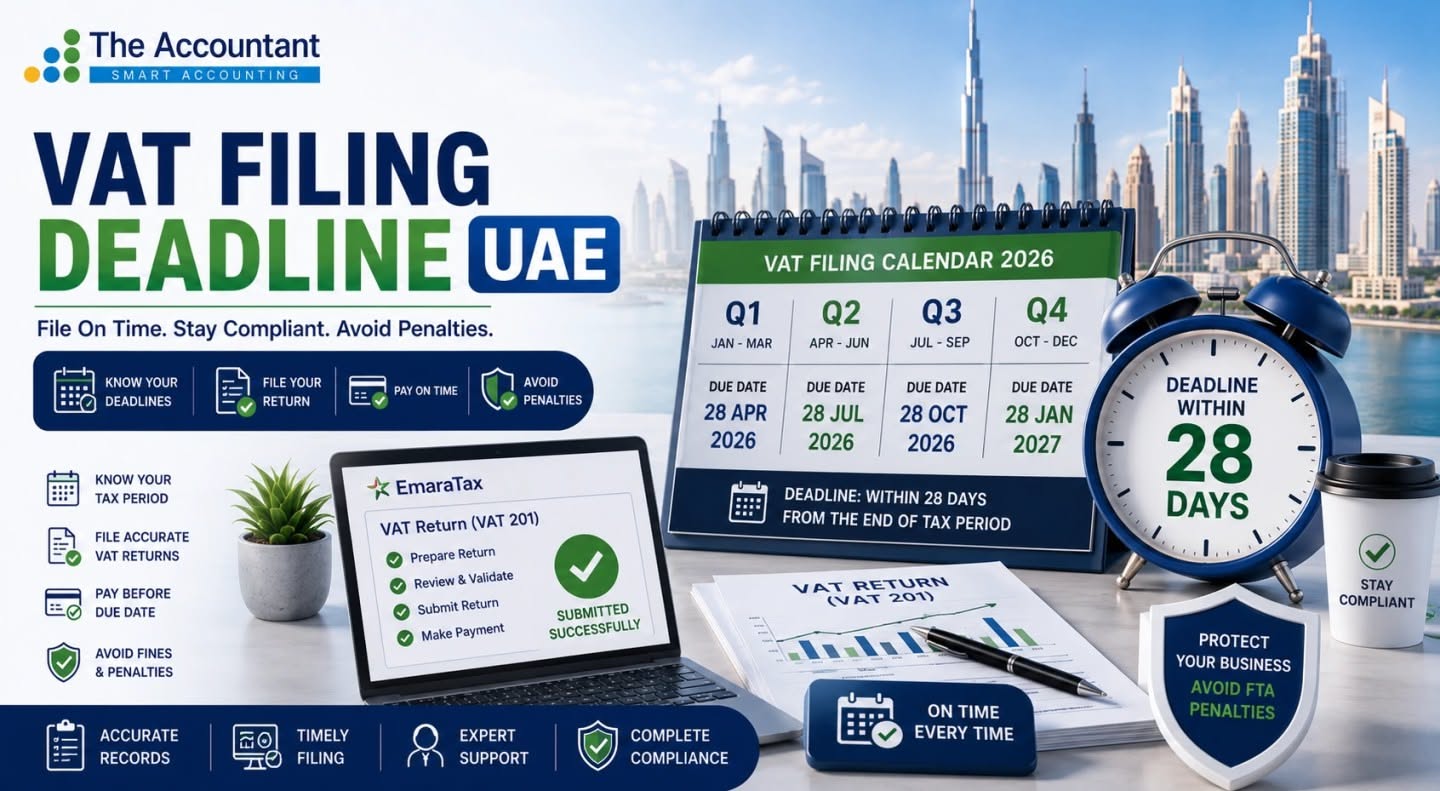
VAT returns must be filed through the EmaraTax portal within 28 days from the end of the tax period. For a quarterly period ending 31 March, the return is due by 28 April.
What the Return Includes
The UAE VAT return (Form VAT 201) requires disclosure of:
- Standard-rated supplies: Total value and VAT amount
- Zero-rated supplies: Total value (VAT amount is zero)
- Exempt supplies: Total value
- Supplies subject to reverse charge: Where the recipient accounts for VAT instead of the supplier
- Input VAT: Total VAT incurred on purchases, categorized by standard-rated, imports, and adjustments
- Net VAT payable or refundable: Output VAT minus recoverable input VAT
Payment
Any net VAT payable must be remitted to the FTA by the same 28-day deadline. Payment can be made via bank transfer, e-Dirham card, or credit/debit card through the EmaraTax portal.
If input VAT exceeds output VAT, the excess can be:
- Carried forward to offset against future VAT liabilities
- Claimed as a refund (subject to FTA review, which may take several months)
Designated Zones (Free Zones and VAT)
Certain free zones are designated as “designated zones” for VAT purposes under Cabinet Decision No. 59 of 2017 (as amended). These zones receive special VAT treatment for goods, though not for services.
Goods in Designated Zones
- Transfer of goods between businesses within the same designated zone: not a supply (no VAT)
- Transfer of goods between different designated zones: not a supply (no VAT, subject to conditions)
- Import of goods into a designated zone from outside the UAE: not subject to import VAT (suspended until goods leave the zone)
- Transfer of goods from a designated zone to mainland UAE: treated as an import and subject to 5% VAT
- Goods consumed within a designated zone: treated as a supply and subject to 5% VAT
Services in Designated Zones
Services supplied to entities in designated zones are not exempt from VAT. The standard 5% rate applies to all services regardless of whether the supplier or recipient is in a designated zone. This is a common misconception.
The VAT-designated zone list is separate from the corporate tax designated free zone list. A free zone may be designated for corporate tax purposes (allowing QFZP status) but not for VAT purposes, or vice versa. Businesses must verify their free zone’s status under both regimes. The FTA maintains updated lists for each designation.
Operating in a VAT-designated zone provides significant cash flow advantages for trading companies by deferring import VAT until goods leave the zone.
For context on the corporate tax treatment of free zone income, see our free zone tax benefits guide.
Tax Invoices
VAT-registered businesses must issue a tax invoice for all taxable supplies. There are two types:
Full Tax Invoice
Required for supplies exceeding AED 10,000. Must include:
- Supplier’s name, address, and TRN
- Recipient’s name, address, and TRN (if registered)
- Sequential invoice number
- Date of issue and date of supply
- Description of goods or services
- Quantity and unit price
- Discount amount (if any)
- Taxable amount (before VAT)
- VAT rate applied
- VAT amount in AED
- Total amount payable
Simplified Tax Invoice
Permitted for supplies of AED 10,000 or less. Must include the supplier’s name, TRN, date of supply, description of goods or services, total amount payable, and VAT amount.
Record Keeping
All VAT records, including tax invoices, credit notes, debit notes, import documents, and accounting records, must be retained for a minimum of 5 years from the end of the tax period to which they relate. For real property, records must be retained for 15 years.
Penalties
The FTA enforces a comprehensive penalty framework for VAT non-compliance. Key penalties include:
| Violation | Penalty |
|---|---|
| Late VAT registration | AED 10,000 |
| Failure to file a VAT return on time | AED 1,000 (first offense); AED 2,000 (repeat within 24 months) |
| Late payment of VAT due | 2% of unpaid tax immediately + 4% on the 7th day + 1% daily thereafter (max 300%) |
| Filing an incorrect VAT return | Fixed penalty plus percentage of the tax difference |
| Failure to issue a tax invoice | AED 5,000 per invoice (first offense); AED 10,000 (repeat) |
| Failure to display prices inclusive of VAT | AED 15,000 (first offense); AED 50,000 (repeat) |
| Failure to maintain records | AED 10,000 (first offense); AED 20,000 (repeat) |
| Failure to inform FTA of changes | AED 5,000 (first offense); AED 15,000 (repeat) |
The late payment penalty structure is particularly aggressive. A business that is 30 days late on a VAT payment of AED 100,000 would owe approximately AED 32,000 in penalties (2% immediate + 4% at day 7 + 1% x 23 remaining days). Timely payment is not optional.
Penalty amnesty programs have been offered periodically by the FTA, most recently in 2024. These programs allow businesses to settle outstanding penalties at reduced rates. However, relying on future amnesties is a risky strategy.
The FTA’s compliance enforcement capabilities have increased significantly since 2018, with automated data matching between VAT returns, customs records, and corporate tax filings now identifying discrepancies in near real-time.
VAT and Corporate Tax Interaction
VAT and corporate tax are distinct obligations, but they interact in your financial statements and tax computations:
- VAT collected on sales is held in trust for the FTA and is not recognized as revenue in the income statement. It does not form part of taxable income for corporate tax purposes.
- Recoverable input VAT is offset against output VAT and does not appear as an expense. It has no impact on corporate tax.
- Irrecoverable input VAT (on exempt supplies, non-business expenses, or blocked categories) is recognized as part of the underlying expense. This amount is deductible for corporate tax purposes to the extent the expense itself is deductible.
- VAT penalties and fines paid to the FTA are not deductible for corporate tax purposes.
For a comprehensive treatment of the UAE corporate tax regime, including the 9% rate, free zone qualifying income, and small business relief, see our UAE corporate tax guide.
VAT Groups
Related businesses can apply to form a VAT Group, which is treated as a single taxable person for VAT purposes. This means:
- Intra-group supplies are disregarded (no VAT charge between members)
- One consolidated VAT return is filed for the group
- The representative member is liable for the group’s VAT obligations
Conditions
- Each member must be a UAE-resident taxable person
- The parent must hold at least 50% of the voting rights or value of each member
- Members must be related by business, financial, or regulatory connection
- All members must be VAT-registered or eligible for registration
VAT Groups are particularly useful for holding structures, service companies that provide intra-group services, and groups with significant intercompany transactions that would otherwise generate VAT compliance without any net tax effect.
Reverse Charge Mechanism
The reverse charge mechanism applies when a UAE-registered business receives services from a supplier who is not registered for UAE VAT (typically a foreign supplier). Instead of the supplier charging VAT, the recipient accounts for VAT on the supply.
The recipient reports both the output VAT (as if they had been charged) and the input VAT (subject to normal recovery rules) on the same return. If the input VAT is fully recoverable, the net effect is zero. If the supply relates to exempt activities, the output VAT is payable but the input VAT is not recoverable.
Common reverse charge scenarios include:
- Foreign consulting or professional services
- Software licenses from overseas providers
- Management fees from foreign parent companies
- Digital services from non-UAE suppliers
Practical Compliance Steps
For businesses operating in the UAE, the following steps ensure robust VAT compliance:
- Determine registration obligation: Calculate total taxable supplies and imports over the trailing 12 months and the projected next 30 days
- Register through EmaraTax: Complete the registration process and obtain your TRN before making taxable supplies
- Classify all supplies: Categorize each product and service as standard-rated, zero-rated, or exempt
- Issue compliant tax invoices: Ensure every taxable supply is supported by a valid tax invoice with all required fields
- Track input VAT: Maintain records of all VAT paid on purchases, categorized by recoverability
- File returns on time: Submit VAT returns within 28 days of the end of each tax period
- Pay on time: Remit net VAT payable by the filing deadline to avoid late payment penalties
- Reconcile quarterly: Compare VAT return figures with accounting records and customs data
- Retain records: Maintain all VAT records for at least 5 years (15 years for real property)
- Review apportionment annually: If making both taxable and exempt supplies, perform the annual input VAT adjustment
Conclusion
UAE VAT at 5% is a relatively simple tax in terms of rate, but its application involves genuine complexity in supply classification, input tax recovery, designated zone rules, and penalty avoidance.
Since its introduction in 2018, the Federal Tax Authority has progressively strengthened its enforcement capabilities, and businesses that treated VAT as an afterthought in the early years are now facing audits, assessments, and penalties.
For businesses establishing operations in the UAE, VAT compliance should be built into the operational framework from day one. This means proper accounting systems, trained finance staff, correct invoicing procedures, and timely filing. The 5% rate is manageable, but the penalties for non-compliance are not.
For related guidance on business setup and tax planning in the UAE, explore our UAE corporate tax guide, free zone tax benefits, company formation guide, and UAE business laws overview.
Related Corpy Resources
- UAE & Dubai business guide for a full overview of doing business in UAE & Dubai
- Corporate tax in UAE & Dubai for related articles on this topic
- Company formation in UAE & Dubai to explore adjacent considerations
- Business laws in UAE & Dubai to explore adjacent considerations
- Free zones in UAE & Dubai to explore adjacent considerations