

What CPF contributions must a Singapore employer pay?
For employees aged 55 and below earning monthly wages above SGD 750, the employer must contribute 17% of the employee’s ordinary wages to the Central Provident Fund (CPF), while the employee contributes 20%. The total CPF contribution is 37% of ordinary wages.
Singapore’s employment law framework is designed to balance employer flexibility with employee protection, creating a labor market that is both competitive and fair. The Ministry of Manpower (MOM) is the primary regulatory authority, administering the Employment Act, the Central Provident Fund (CPF) system, work injury compensation, foreign worker policies, and fair employment practices.
For any business hiring employees in Singapore, whether local or foreign, understanding these obligations is essential for compliance and for building a productive workforce.
This guide covers the key aspects of Singapore employment law as of 2026, including the Employment Act’s coverage and provisions, CPF contribution obligations, work injury compensation requirements, leave entitlements, retirement and re-employment regulations, and fair employment practices.
Our research team has compiled this information from current MOM regulations, the Employment Act 1968, the CPF Act, and Tripartite Guidelines.
Employment Act Coverage
The Employment Act is Singapore’s primary employment legislation, covering all employees under a contract of service with an employer, with the exception of seafarers (covered by the Merchant Shipping Act), domestic workers (covered by the Employment of Foreign Manpower Act), and statutory board employees and civil servants (covered by their respective terms of service).
Part IV Protections
Part IV of the Employment Act provides additional protections regarding hours of work, overtime, rest days, and other working conditions. Part IV applies to workmen earning up to SGD 4,500 per month and to non-workmen employees earning up to SGD 2,600 per month.
Managers and executives earning more than SGD 4,500 per month are covered by the general provisions of the Employment Act (termination, salary payment, leave) but are excluded from Part IV provisions.
| Employee Category | Employment Act Coverage | Part IV Coverage |
|---|---|---|
| Workmen earning up to SGD 4,500/month | Full coverage | Full coverage |
| Non-workmen earning up to SGD 2,600/month | Full coverage | Full coverage |
| Non-workmen earning SGD 2,601-4,500/month | Full coverage | Partial (overtime limits) |
| Managers/executives above SGD 4,500/month | General provisions only | Not covered |
| Foreign employees | Same as local employees | Same thresholds apply |
| Domestic workers | Not covered | Not covered |
Central Provident Fund (CPF) Obligations
The CPF is Singapore’s mandatory social security savings scheme. Employers must make CPF contributions for all employees who are Singapore Citizens or Permanent Residents earning more than SGD 50 per month. CPF does not apply to foreign employees on work permits, S Passes, or Employment Passes.
CPF Contribution Rates
The standard CPF contribution rates for employees aged 55 and below are 17% from the employer and 20% from the employee, for a total of 37% of ordinary wages. The employee’s contribution is deducted from their salary, while the employer’s contribution is an additional cost above the gross salary.
| Employee Age | Employer Rate | Employee Rate | Total Rate |
|---|---|---|---|
| 55 and below | 17% | 20% | 37% |
| Above 55 to 60 | 14.5% | 15% | 29.5% |
| Above 60 to 65 | 11% | 9.5% | 20.5% |
| Above 65 to 70 | 7.5% | 7% | 14.5% |
| Above 70 | 5% | 5% | 10% |
CPF Wage Ceilings
CPF contributions are subject to a monthly ordinary wage (OW) ceiling of SGD 6,800. Wages above this ceiling are not subject to CPF contributions for the ordinary wage component. There is also an annual total wage ceiling that caps CPF contributions on the combined ordinary and additional wages (bonuses, overtime).
Graduated Employer Contribution for Permanent Residents
During the first two years of obtaining PR status, reduced CPF rates apply. In the first year, the employer contributes 4% (or graduated rate) and the employee contributes 5%. In the second year, the rates increase to 9% (employer) and 15% (employee). Full rates apply from the third year onward.
CPF contributions represent a significant employment cost in Singapore. For an employee earning SGD 5,000 per month, the employer’s CPF contribution is SGD 850 per month (SGD 10,200 per year), bringing the total employment cost to SGD 5,850 per month. Employers should factor CPF into their budgeting and salary negotiations.
The employer’s CPF contribution is fully tax-deductible as a business expense, which partially offsets the cost for profitable companies.
Employment Contracts
While Singapore law does not mandate a written employment contract, MOM strongly recommends that all employers issue written contracts to employees. The Key Employment Terms (KET) provision requires employers with 5 or more employees to issue written KETs to every employee within 14 days of commencing employment.
The KETs must include the job title and description, start date of employment, duration of employment (if fixed-term), working hours and rest days, salary details (basic salary, allowances, deductions, overtime rate), leave entitlements, and notice period for termination.
Salary and Payment
Payment Timing
Salaries must be paid at least once a month, within 7 days after the end of the salary period. Overtime pay must be paid within 14 days after the end of the salary period. Salary upon termination must be paid within 3 working days of the termination date (or the last day of employment if resignation).
Salary Deductions
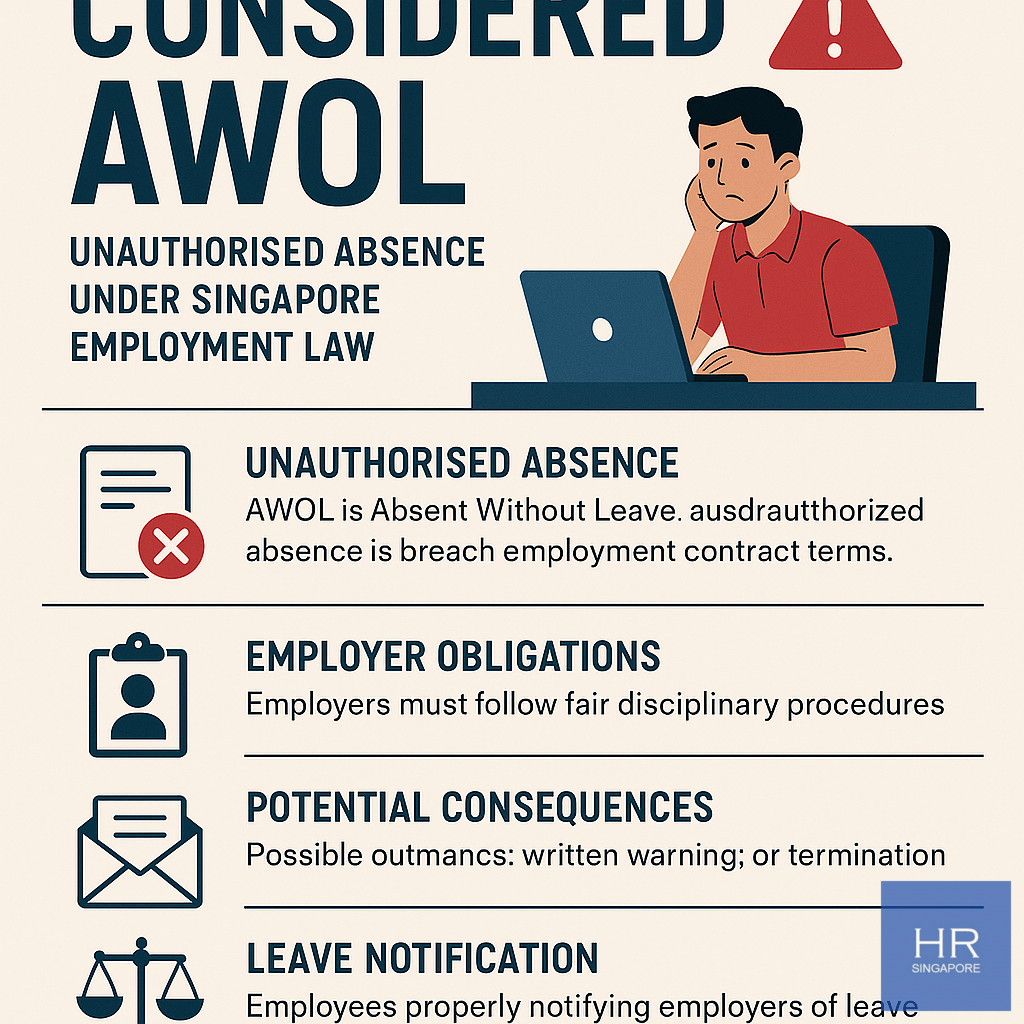
Employers can only make deductions from an employee’s salary in the following circumstances: CPF contributions (mandatory), income tax deductions under the Auto-Inclusion Scheme, deductions authorized in writing by the employee, deductions ordered by a court, and deductions for absence from work without authorization or valid reason.
Total deductions (excluding CPF) must not exceed 50% of the salary payable in any salary period.
Unauthorized salary deductions are a common compliance violation in Singapore. Employers cannot deduct amounts for damage to property, losses, or poor performance without a court order, even if the employment contract purports to authorize such deductions.
MOM actively investigates complaints about unauthorized deductions and can require employers to repay deducted amounts, impose penalties, and in serious cases, prosecute the employer.
Leave Entitlements
Annual Leave
Employees who have served for at least 3 months are entitled to paid annual leave. The minimum entitlement is 7 days for the first year of service, increasing by 1 day per year up to a maximum of 14 days after 8 or more years of service.
| Years of Service | Minimum Annual Leave (Days) |
|---|---|
| 1st year | 7 |
| 2nd year | 8 |
| 3rd year | 9 |
| 4th year | 10 |
| 5th year | 11 |
| 6th year | 12 |
| 7th year | 13 |
| 8th year and beyond | 14 |
Sick Leave
Employees who have served for at least 6 months are entitled to paid sick leave of 14 days per year for outpatient sick leave and 60 days per year for hospitalization leave (inclusive of the 14 outpatient days). The employee must be certified unfit for work by a company-appointed or government doctor.
Maternity and Paternity Leave
Female employees are entitled to 16 weeks of government-paid maternity leave for the first two children (employer pays the first 8 weeks, government reimburses the last 8 weeks, up to a cap) and for the third and subsequent children (government pays all 16 weeks, up to a cap). Male employees are entitled to 2 weeks of government-paid paternity leave.
Shared parental leave allows fathers to share up to 4 weeks of the mother’s maternity leave.
Other Leave Types
Childcare leave provides 6 days per year for parents of children under 7 years old. Extended childcare leave provides 2 days per year for parents of children aged 7 to 12. Unpaid infant care leave provides 6 days per year for parents of children under 2.
Work Injury Compensation
The Work Injury Compensation Act (WICA) provides a no-fault compensation framework for employees who suffer injuries or contract diseases in the course of employment. Employers must purchase Work Injury Compensation Insurance for all employees doing manual work (regardless of salary) and all employees earning SGD 2,600 or less per month.
WICA covers medical expenses, temporary incapacity (paid as a percentage of average monthly earnings), permanent incapacity (lump sum based on the degree of incapacity and age), and death benefits (lump sum to dependents). Claims are administered by MOM, and the process does not require the employee to prove employer negligence.
Retirement and Re-Employment
Retirement Age: 63
The minimum retirement age in Singapore is 63. Employers cannot dismiss an employee, or require them to retire, before the age of 63 on the basis of age alone. Any dismissal of an employee approaching retirement age must be based on legitimate grounds such as poor performance, misconduct, or redundancy.
Re-Employment Age: 68
Employers must offer re-employment to eligible employees who reach the retirement age of 63, up until the employee turns 68. The re-employment offer must be on terms that are reasonable and similar to the employee’s existing terms, though the employer may adjust duties, working hours, or salary to reflect the employee’s changed capabilities or the employer’s needs.
The retirement and re-employment framework requires careful planning by employers. When an employee approaches 63, the employer should assess whether to offer continued employment on existing terms, offer re-employment on modified terms, or provide an Employment Assistance Payment (EAP) if re-employment cannot be offered.
The EAP amount is negotiated between the employer and employee, with a recommended minimum of 3.5 months’ salary, subject to a cap of SGD 6,250.
If the employer genuinely cannot offer re-employment due to business reasons, the employer must provide a one-off Employment Assistance Payment (EAP) to the employee. The EAP should be at least 3.5 months of the employee’s salary or SGD 6,250, whichever is higher, though this amount may be adjusted through future legislative updates.
Fair Employment Practices
The Tripartite Alliance for Fair and Progressive Employment Practices (TAFEP) enforces the Tripartite Guidelines on Fair Employment Practices. These guidelines require employers to recruit based on merit (skills, qualifications, experience) rather than on age, race, gender, religion, marital status, family responsibilities, or disability.
Workplace Fairness Legislation
Singapore has strengthened its fair employment framework with the Workplace Fairness Legislation, which provides statutory protection against workplace discrimination based on protected characteristics. Employers who discriminate in hiring, promotion, or termination based on protected characteristics may face penalties and orders to compensate affected employees.
Fair Consideration Framework
The Fair Consideration Framework (FCF) requires employers to consider Singaporeans fairly for all positions before hiring foreigners. Employers must advertise job vacancies on MyCareersFuture for at least 14 days before submitting a work pass application for a foreign candidate. The advertising requirement applies to positions with a salary below SGD 22,500 per month.
Employers placed on the FCF watchlist for suspected discriminatory practices may face restrictions on work pass applications.
Foreign Worker Regulations
Employers hiring foreign workers must comply with MOM’s work pass framework. The three main work pass categories are the Employment Pass (EP) for professionals earning at least SGD 5,000 per month, the S Pass for mid-level skilled staff earning at least SGD 3,150 per month, and the Work Permit for semi-skilled workers in specific sectors.
Each category has specific quota restrictions (dependency ratio ceilings), levy requirements, and eligibility criteria. Employers must ensure that work pass holders perform only the jobs specified in their work pass and that their employment conditions comply with all applicable regulations.
For details on work pass options for company directors and entrepreneurs, see our guides on the Singapore EntrePass and Singapore Employment Pass.
Termination of Employment
Notice Period
Either party can terminate employment by giving the notice period specified in the employment contract. If no notice period is specified, the statutory minimum notice periods apply: 1 day during the first 26 weeks, 1 week for 26 weeks to 2 years, 2 weeks for 2 to 5 years, and 4 weeks for 5 years or more.
Wrongful Dismissal
Employees who believe they have been wrongfully dismissed can file a claim with the Tripartite Alliance for Dispute Management (TADM) within 1 month of the dismissal.
Wrongful dismissal includes termination without just cause, termination in retaliation for exercising employment rights, and constructive dismissal where the employer’s conduct leaves the employee no reasonable choice but to resign.
Employment Dispute Resolution
Singapore provides a structured framework for resolving employment disputes, encouraging mediation before escalation to formal proceedings.
Tripartite Alliance for Dispute Management (TADM)
TADM handles employment disputes through mediation, where a trained mediator helps both parties reach an agreement. Most salary-related claims must be filed with TADM before they can be referred to the Employment Claims Tribunal. There is no charge for TADM mediation services.
Employment Claims Tribunal (ECT)
If mediation at TADM fails, the dispute can be escalated to the ECT, which handles statutory salary-related claims. The ECT can award claims of up to SGD 20,000 (or SGD 30,000 if the claim is referred by TADM or a trade union). The filing fee is SGD 30 for claims up to SGD 10,000 and SGD 60 for claims above SGD 10,000.
Lawyers are generally not permitted to represent parties at the ECT, keeping the process accessible and affordable.
Claims Timeline
Employees must file salary-related claims within 1 year of the last payment date for current employees, or within 6 months of leaving employment for former employees. Wrongful dismissal claims must be filed within 1 month of the dismissal date.
Workplace Safety and Health
The Workplace Safety and Health Act (WSHA) places the primary responsibility for workplace safety on employers.
Key requirements include conducting risk assessments for all workplace activities, implementing control measures to eliminate or reduce identified risks, providing safety training and personal protective equipment, reporting workplace accidents, dangerous occurrences, and occupational diseases to MOM, and maintaining safe premises, equipment, and work processes.
Penalties for WSHA violations can be severe, including fines of up to SGD 500,000 and imprisonment of up to 2 years for individuals, and fines of up to SGD 500,000 for companies. Repeat offenders face higher penalties. MOM conducts regular workplace inspections and investigates all reported workplace incidents.
Conclusion
Singapore’s employment law framework provides clear rules and predictable obligations for employers. The key financial obligation is CPF contributions (17% employer rate for employees aged 55 and below), which represents the most significant employment-related cost beyond the base salary.
Beyond CPF, employers must comply with leave entitlements, work injury compensation insurance, retirement and re-employment obligations, fair employment practices, and salary payment regulations.
The framework is employer-friendly in terms of flexibility (relatively low minimum leave entitlements, few restrictions on termination with proper notice) while providing essential protections for employees.
For businesses entering the Singapore market, understanding these obligations from the outset ensures smooth operations and avoids the penalties and reputational damage associated with non-compliance.
Related Corpy Resources
- Singapore business guide for a full overview of doing business in Singapore
- Business laws in Singapore for related articles on this topic
- Company formation in Singapore to explore adjacent considerations
- Corporate tax in Singapore to explore adjacent considerations
- Free zones in Singapore to explore adjacent considerations