

What is VARA and how does it regulate crypto in Dubai?
VARA (Virtual Assets Regulatory Authority) is Dubai’s dedicated regulator for virtual assets and related activities, established in 2022 under Law No. 4 of 2022. It is the world’s first independent government authority specifically created to regulate virtual assets.
VARA licenses and supervises all virtual asset service providers (VASPs) operating in or from Dubai, excluding the DIFC which has its own.
The UAE has emerged as one of the world’s most significant jurisdictions for cryptocurrency and virtual asset businesses.
While many countries have responded to the growth of digital assets with restrictive regulation or outright bans, the UAE took the opposite approach: creating dedicated regulatory frameworks specifically designed for virtual assets, offering clear licensing pathways, and actively courting global crypto companies to establish operations within its borders.
The result is a regulatory environment that provides the legitimacy institutional players demand while maintaining the innovation-friendly posture that attracts startups and emerging projects.
This guide provides a comprehensive analysis of the UAE’s virtual asset regulatory landscape in 2026, covering the VARA framework in Dubai, the ADGM framework in Abu Dhabi, licensing requirements, permitted activities, compliance obligations, and the practical considerations for companies looking to operate in or from the UAE.
Regulatory Architecture
The UAE’s approach to crypto regulation is distinctive in that it involves multiple regulatory authorities operating across different jurisdictions within the country. Understanding this architecture is essential before pursuing any licensing pathway.
Federal Level
At the federal level, the Securities and Commodities Authority (SCA) has oversight of virtual asset activities across the UAE, excluding the financial free zones (DIFC and ADGM). However, Dubai has established its own authority - VARA - which operates under a specific Dubai law and has primary regulatory responsibility within Dubai’s jurisdiction.
Dubai: VARA (Virtual Assets Regulatory Authority)
VARA was established in 2022 under Dubai Law No. 4 of 2022, making it the world’s first independent government authority dedicated exclusively to virtual asset regulation. VARA regulates all virtual asset service providers (VASPs) operating in or from Dubai, with the exception of entities operating within the DIFC (which has its own regulatory framework).
Abu Dhabi: ADGM (Abu Dhabi Global Market)
The Abu Dhabi Global Market’s Financial Services Regulatory Authority (FSRA) has been regulating virtual asset activities since 2018, making it one of the earliest regulators globally to create a comprehensive framework for crypto businesses. The FSRA operates under its own legal framework based on English common law.
DIFC (Dubai International Financial Centre)
The DIFC has its own framework for investment tokens and crypto assets through the Dubai Financial Services Authority (DFSA). The DFSA’s approach is more conservative, focusing primarily on investment tokens and security tokens rather than the broader virtual asset ecosystem.
| Jurisdiction | Regulator | Legal Framework | Scope |
|---|---|---|---|
| Dubai (excluding DIFC) | VARA | Dubai Law No. 4 of 2022 | All virtual asset activities in Dubai |
| Abu Dhabi (ADGM) | FSRA | ADGM Virtual Asset Framework | Virtual asset activities within ADGM |
| DIFC | DFSA | DFSA Investment Token Framework | Investment tokens and security tokens |
| Federal (other emirates) | SCA | Federal virtual asset regulations | Virtual asset activities outside Dubai and financial free zones |
The multi-regulator structure can be confusing, but it also offers options. A company primarily focused on retail crypto exchange services might choose VARA in Dubai for its dedicated crypto expertise and market access. A company focused on institutional trading or fund management might prefer ADGM for its English common law framework and established financial services ecosystem.
Understanding which regulator aligns with your business model is the first strategic decision.
VARA: Dubai’s Virtual Asset Regulator
Regulated Activities
VARA regulates seven categories of virtual asset activities. Any entity wishing to conduct these activities in or from Dubai must obtain the appropriate VARA license:
- Advisory Services: Providing advice on virtual assets, including investment advice, portfolio management advice, and market analysis
- Broker-Dealer Services: Facilitating virtual asset transactions on behalf of clients, including order routing and execution
- Custody Services: Safekeeping and management of virtual assets or the means of access to virtual assets (private keys) on behalf of clients
- Exchange Services: Operating a platform for the exchange of virtual assets, including order matching, price discovery, and trade execution
- Lending and Borrowing Services: Providing virtual asset lending, borrowing, or collateralized financing services
- Transfer and Settlement Services: Providing virtual asset transfer, clearing, and settlement services
- VA Management and Investment Services: Managing virtual asset portfolios or investment schemes on behalf of clients
Licensing Process
VARA’s licensing process follows a phased approach designed to ensure that only adequately prepared companies receive full operating licenses:
Phase 1: Initial Application
- Submit application through VARA’s portal
- Provide company documentation, business plan, and compliance framework
- Pay initial application fee
- VARA conducts preliminary assessment (4-6 weeks)
Phase 2: Minimum Viable Product (MVP) License
- Approved applicants receive an MVP license
- Operate under restricted conditions (limited customers, transaction volumes, or asset types)
- Demonstrate operational capability, compliance, and risk management
- Duration: typically 6-12 months
Phase 3: Full Market Product (FMP) License
- Upon satisfactory MVP performance, apply for FMP license
- Full operational capabilities
- No restrictions on customer base or transaction volumes (subject to ongoing compliance)
- Annual renewal required
| Licensing Phase | Duration | Scope | Key Requirements |
|---|---|---|---|
| Application review | 4-6 weeks | Assessment only | Complete application, fees, documentation |
| MVP License | 6-12 months | Restricted operations | Demonstrate compliance, technology, and risk management |
| FMP License | Ongoing (annual renewal) | Full operations | Maintain all compliance standards, regular reporting |
Compliance Requirements
VARA imposes comprehensive compliance obligations on licensed VASPs:
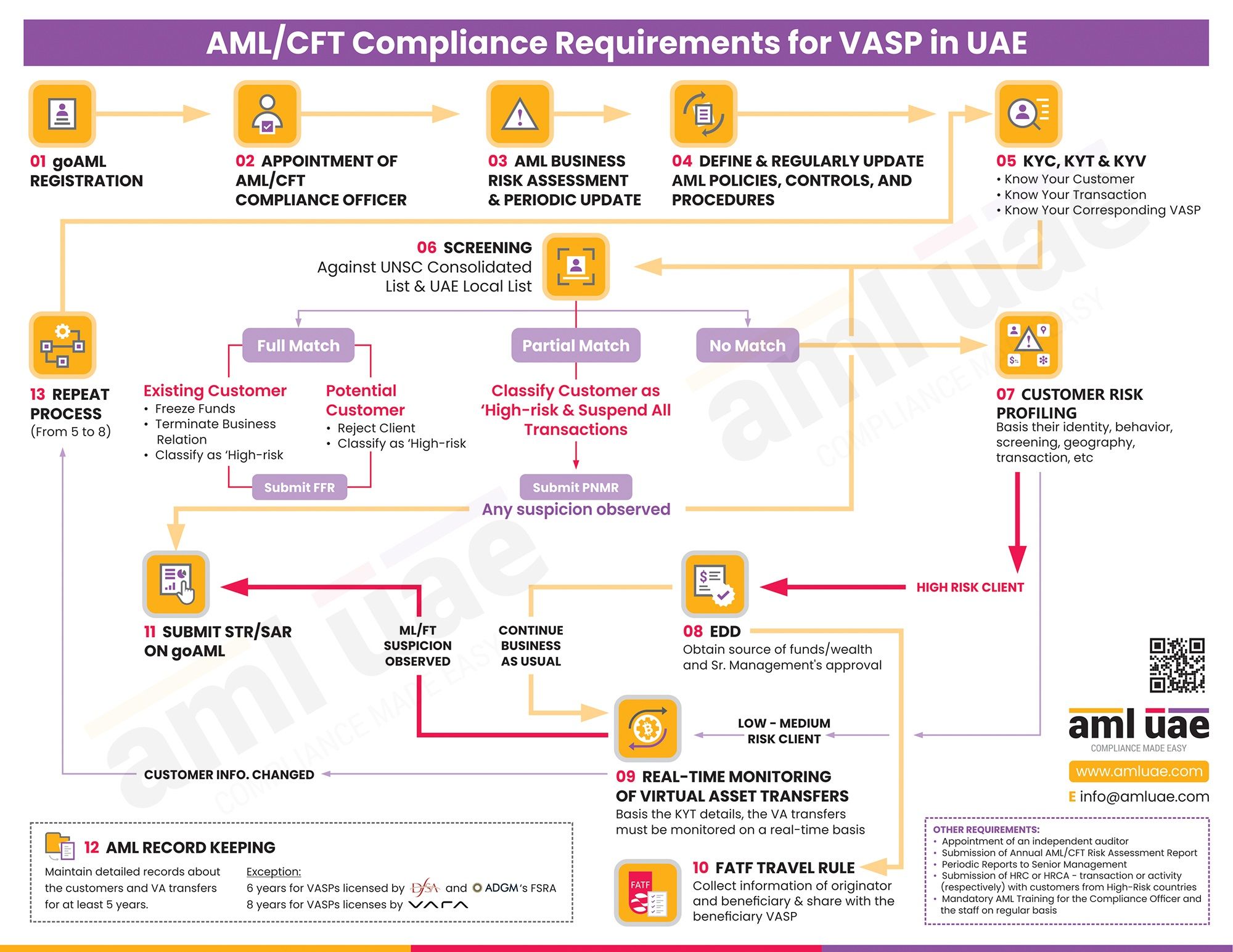
Anti-Money Laundering (AML/CFT):
- Implement a risk-based AML/CFT framework
- Conduct Customer Due Diligence (CDD) and Enhanced Due Diligence (EDD)
- Implement transaction monitoring and suspicious transaction reporting
- Register with goAML (the UAE’s financial intelligence reporting platform)
- Conduct Travel Rule compliance for virtual asset transfers
Technology and Security:
- Implement robust cybersecurity measures aligned with recognized standards
- Conduct regular penetration testing and security audits
- Maintain business continuity and disaster recovery plans
- Implement hot/cold wallet management with appropriate security controls
- Undergo technology assessments by VARA-approved auditors
Financial Requirements:
- Maintain minimum capital requirements based on activity type and scale
- Hold client assets separately from company assets (segregation)
- Maintain adequate insurance or equivalent financial protection
- Submit audited financial statements annually
- Report financial position to VARA on a regular basis
Market Conduct:
- Implement fair dealing and best execution policies
- Provide clear, accurate, and non-misleading disclosures to customers
- Implement conflict of interest management frameworks
- Maintain orderly market procedures (for exchanges)
- Comply with VARA’s marketing and promotion guidelines
VARA’s compliance standards are deliberately rigorous. The regulator has stated publicly that its goal is to create a “gold standard” regulatory framework that attracts serious, well-capitalized companies while filtering out bad actors.
Companies approaching VARA should expect a thorough, multi-month licensing process and should invest in proper compliance infrastructure before applying. Underprepared applications are rejected or delayed, costing time and credibility.
ADGM: Abu Dhabi’s Framework
FSRA Virtual Asset Framework
The ADGM’s Financial Services Regulatory Authority was one of the first regulators globally to introduce a comprehensive virtual asset regulatory framework, with its initial guidance published in 2018 and subsequently updated. The framework is based on principles from the Financial Action Task Force (FATF) and aligns with international regulatory standards.
Regulated Activities in ADGM
- Operating a Crypto Asset Exchange: Matching orders for buying and selling crypto assets
- Dealing in Crypto Assets: Buying and selling as principal or agent
- Managing Crypto Assets: Managing portfolios of crypto assets for clients
- Providing Custody of Crypto Assets: Safekeeping and administration of crypto assets
- Arranging Crypto Asset Deals: Bringing parties together for crypto asset transactions
ADGM Licensing Requirements
| Requirement | Details |
|---|---|
| Capital requirements | Varies by activity; minimum AED 500,000 for most activities |
| Technology standards | Must meet ADGM technology governance requirements |
| AML/CFT framework | Full compliance with ADGM’s AML rules and FATF standards |
| Audit | Annual independent audit by ADGM-registered auditor |
| Insurance | Professional indemnity and cyber insurance required |
| Staff qualifications | Key personnel must meet fit and proper requirements |
| Reporting | Regular financial and operational reporting to FSRA |
ADGM vs VARA: Key Differences
| Factor | VARA (Dubai) | ADGM (Abu Dhabi) |
|---|---|---|
| Legal system | Dubai civil law + VARA regulations | English common law (ADGM) |
| Target market | Broad retail and institutional | Primarily institutional and professional |
| Licensing approach | MVP then FMP (phased) | Direct licensing with conditions |
| Regulatory maturity | Established 2022, rapidly developing | Established 2018, more established framework |
| Physical presence | Required in Dubai | Required within ADGM (Al Maryah Island) |
| Market perception | Innovation-focused, high-profile | Conservative, institution-focused |
| Notable licensees | Binance, OKX, Bybit, Crypto.com | Several institutional platforms |
| Stablecoin regulation | Specific stablecoin rules | Covered under broader framework |
Why the UAE Is Becoming a Global Crypto Hub
The UAE’s rise as a crypto hub is not accidental. It results from a deliberate government strategy combining several factors:
Regulatory Clarity
Unlike jurisdictions where crypto businesses operate in legal grey areas, the UAE provides clear licensing pathways with defined rules. Companies know exactly what is required, what is permitted, and what the consequences of non-compliance are. This clarity attracts businesses that want to operate legitimately and reduces the regulatory risk that haunts the industry in many other markets.
Tax Environment
The UAE’s tax framework is favorable for crypto businesses:
- No personal income tax on crypto gains for individuals
- Corporate tax at 9% on profits above AED 375,000 (with potential free zone QFZP benefits)
- No capital gains tax
- VAT exemption for certain virtual asset transactions
Strategic Location
The UAE occupies a timezone that bridges Asian and European markets, with trading hours overlapping with both regions. This geographic advantage is significant for 24⁄7 crypto markets where teams need to cover Asian morning trading, European midday activity, and US market opening.
Infrastructure
World-class internet connectivity, reliable power infrastructure, modern office spaces, and a cosmopolitan lifestyle make the UAE an attractive base for crypto companies recruiting global talent.
Government Engagement
UAE government entities actively engage with the crypto industry. Dubai’s DMCC established a Crypto Centre, the Dubai government accepted crypto payments for government services, and senior officials regularly participate in industry events. This top-down support signals long-term commitment to the sector.
The UAE’s crypto-friendly reputation should not be confused with a lack of regulation. The country has invested heavily in regulatory infrastructure precisely because it wants to attract legitimate businesses while maintaining international compliance standards.
Companies that view the UAE as a regulatory haven where anything goes will be disappointed - VARA and FSRA enforce their rules rigorously and have rejected applications from companies that fail to meet compliance standards.
Practical Considerations for Crypto Businesses
Banking
Banking relationships remain the most significant practical challenge for crypto businesses in the UAE, as globally. While the regulatory frameworks provide licensing clarity, many UAE banks remain cautious about servicing virtual asset companies.
ADCB, Emirates NBD, and some digital banks have shown increasing willingness to work with licensed VASPs, but opening and maintaining banking relationships requires proactive relationship management and robust AML compliance.
For general banking guidance, see our UAE business bank account guide.
Talent
The UAE has attracted significant crypto and blockchain talent, with Dubai and Abu Dhabi hosting a growing community of developers, compliance professionals, and business operators. The UAE’s visa programs, including the Golden Visa and specialized tech visas, facilitate hiring international talent.
Cost
Licensing costs for crypto businesses are substantial:
| Cost Element | VARA (Approximate) | ADGM (Approximate) |
|---|---|---|
| Application fee | AED 40,000 - 100,000 | AED 25,000 - 50,000 |
| Annual license fee | AED 50,000 - 200,000 | AED 30,000 - 75,000 |
| Minimum capital | AED 1,000,000 - 5,000,000+ | AED 500,000 - 2,000,000+ |
| Compliance infrastructure | AED 200,000 - 500,000/year | AED 150,000 - 400,000/year |
| Office space | AED 50,000 - 200,000/year | AED 60,000 - 250,000/year |
| Total first year (estimated) | AED 1,500,000 - 5,000,000+ | AED 800,000 - 3,000,000+ |
Stablecoins and Central Bank Digital Currency
The UAE Central Bank has been developing its own central bank digital currency (CBDC) and has issued specific regulations regarding stablecoin issuance. VARA has published rules for Payment Token Service Providers, which cover stablecoin issuance and management. Companies involved in stablecoin activities should expect additional regulatory requirements beyond standard VASP licensing.
Compliance Checklist for UAE Crypto Businesses
- [ ] Determine the correct regulatory authority (VARA, ADGM, DIFC, or SCA)
- [ ] Prepare a comprehensive business plan and regulatory application
- [ ] Establish AML/CFT policies and procedures
- [ ] Implement Travel Rule compliance
- [ ] Set up technology infrastructure meeting regulatory standards
- [ ] Obtain required insurance coverage
- [ ] Appoint qualified compliance officer and MLRO
- [ ] Register with goAML
- [ ] Establish banking relationships
- [ ] Implement client asset segregation
- [ ] Conduct pre-application cybersecurity assessment
- [ ] Prepare for ongoing reporting and regulatory engagement
Conclusion
The UAE’s approach to virtual asset regulation represents a model that other jurisdictions are studying and, in some cases, emulating. By creating dedicated authorities (VARA), establishing clear licensing categories, and maintaining rigorous compliance standards, the UAE has attracted major global crypto companies while building a reputation for regulatory seriousness.
For companies considering the UAE as a base for crypto or virtual asset operations, the key message is clear: the opportunity is real, but so are the requirements. Licensing takes months, compliance costs are substantial, and ongoing regulatory engagement is expected.
Companies that approach the process with proper preparation, adequate capital, and genuine commitment to compliance will find the UAE an excellent jurisdiction for building a global crypto business.
Taxation of Crypto Activities
Virtual asset businesses in the UAE are subject to the standard corporate tax framework. Key tax considerations include:
- Corporate tax: 9% on taxable income exceeding AED 375,000. Free zone crypto companies may qualify for 0% on qualifying income if they meet QFZP status requirements.
- VAT treatment: The transfer of virtual assets is generally treated as an exempt financial service for VAT purposes, though the FTA has not issued comprehensive guidance on all crypto transaction types.
- Personal crypto gains: No personal income tax applies to individuals on crypto trading profits. However, individuals operating crypto activities as a business may be subject to corporate tax.
For comprehensive tax guidance, see our UAE corporate tax guide.
NFTs and Digital Assets Beyond Cryptocurrency
VARA’s regulatory scope extends beyond traditional cryptocurrencies to cover a broader range of virtual assets. Non-fungible tokens (NFTs), utility tokens, and other digital assets may fall under VARA’s jurisdiction depending on their characteristics and use cases.
NFTs that function as investment vehicles or provide rights similar to securities are more likely to require licensing than purely artistic or collectible NFTs. Companies planning to issue, trade, or manage NFTs in or from Dubai should seek regulatory clarification from VARA before launching.
For broader business setup guidance, see our guide to starting a company in Dubai. For free zone considerations relevant to crypto businesses, review our Dubai free zones comparison and mainland vs free zone guide. For the regulatory compliance landscape beyond crypto, see our UAE business laws compliance guide.
Related Corpy Resources
- UAE & Dubai business guide for a full overview of doing business in UAE & Dubai
- Banking in UAE & Dubai for related articles on this topic
- Company formation in UAE & Dubai to explore adjacent considerations
- Corporate tax in UAE & Dubai to explore adjacent considerations
- Business laws in UAE & Dubai to explore adjacent considerations