

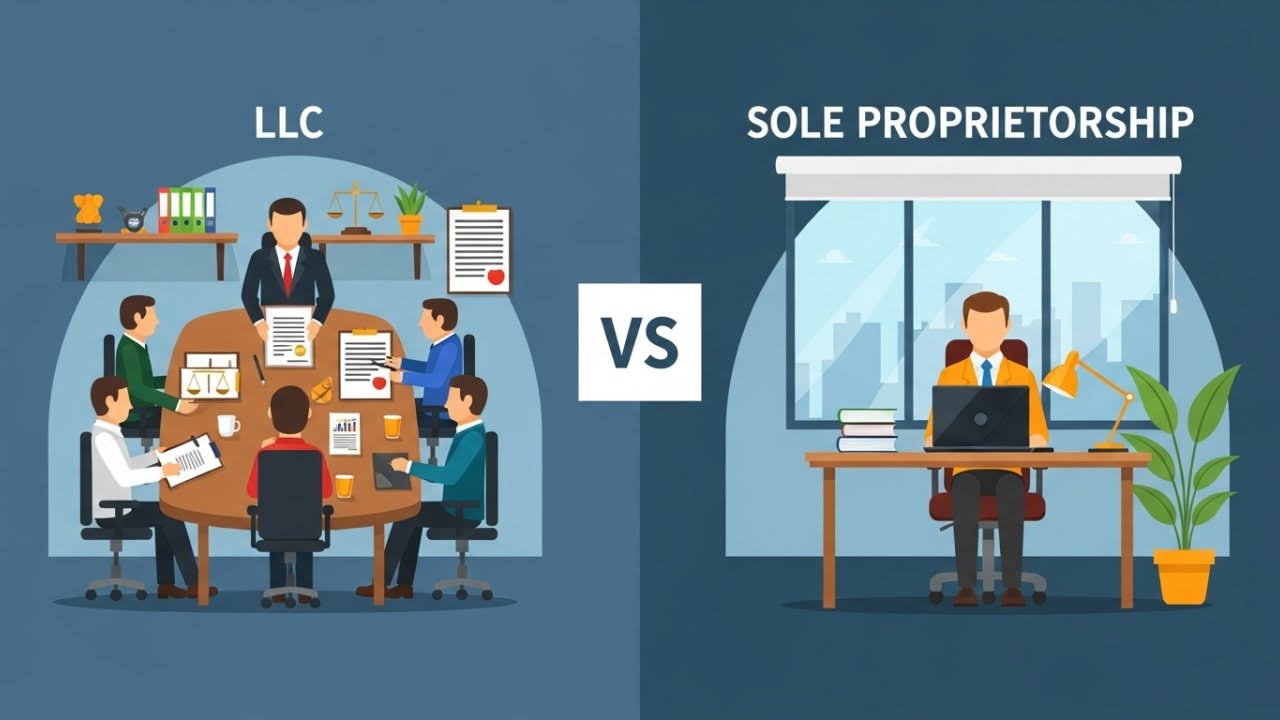
What is the main difference between a Pte Ltd and a Sole Proprietorship in Singapore?
The most significant difference is liability protection. A Pte Ltd (Private Limited Company) is a separate legal entity, meaning the owners’ personal assets are protected from business debts and liabilities. A Sole Proprietorship has no legal separation between the owner and the business, so the owner is personally liable for all debts and obligations.
Choosing the right business structure is one of the most consequential decisions an entrepreneur makes when starting a business in Singapore. The structure you select affects your personal liability exposure, the taxes you pay, your ability to raise capital, your compliance burden, and the perception of your business by clients, partners, and financial institutions.
Singapore offers several business structures, but three dominate the landscape for small and medium enterprises: the Private Limited Company (Pte Ltd), the Sole Proprietorship, and the Limited Liability Partnership (LLP).
This guide provides a comprehensive comparison of these three structures as of 2026, covering their legal characteristics, tax implications, compliance requirements, formation costs, and the scenarios where each structure makes the most sense.
Our research team has analyzed current ACRA regulations, the Companies Act, the Business Names Registration Act, and the Limited Liability Partnerships Act to ensure this information reflects the latest requirements.
Quick Comparison Overview
| Feature | Pte Ltd | Sole Proprietorship | LLP |
|---|---|---|---|
| Legal Entity Status | Separate legal entity | Not a separate entity | Separate legal entity |
| Liability Protection | Full limited liability | No protection (unlimited liability) | Limited liability for partners |
| Minimum Owners | 1 shareholder | 1 owner | 2 partners |
| Maximum Owners | 50 shareholders | 1 owner | No maximum |
| Tax Treatment | Corporate tax at 17% | Personal income tax (up to 22%) | Partners taxed individually |
| Startup Tax Exemption | Yes (first 3 years) | No | No |
| ACRA Registration Fee | SGD 315 | SGD 115 | SGD 165 |
| Annual Filing Required | Annual return (SGD 60) | No annual return | Annual declaration (SGD 60) |
| Company Secretary Required | Yes (mandatory) | No | No (but manager required) |
| Audit Required | Only above threshold | No | No |
| Can Issue Shares | Yes | No | No |
| Perpetual Succession | Yes | No (tied to owner) | Yes |
| Eligible for Government Grants | Most grants available | Limited eligibility | Limited eligibility |
| Perceived Credibility | High | Low to moderate | Moderate |
Private Limited Company (Pte Ltd) in Detail
The Pte Ltd is the gold standard for business structures in Singapore. It is a separate legal entity, meaning the company exists independently from its shareholders and directors. This separation provides the foundation for limited liability protection, perpetual succession, and the ability to own property, enter contracts, and sue or be sued in its own name.
Liability Protection
Shareholders of a Pte Ltd are liable only up to the amount of their unpaid share capital. If the company incurs debts or faces legal claims, the shareholders’ personal assets (homes, savings, personal investments) are protected. This protection is arguably the single most important advantage of the Pte Ltd structure.
The limited liability protection of a Pte Ltd is not absolute. Directors can be held personally liable in cases of fraud, breach of fiduciary duty, trading while insolvent, or providing personal guarantees for company loans.
Nevertheless, for legitimate business operations, the Pte Ltd structure provides a robust shield between business risks and personal wealth that no other common structure in Singapore matches.
Tax Treatment
Pte Ltd companies are taxed at the flat corporate income tax rate of 17%. However, the effective rate is significantly lower for most companies due to two key exemption schemes:
Startup Tax Exemption (first 3 years): 75% exemption on the first SGD 100,000 of chargeable income and 50% exemption on the next SGD 100,000. This means a qualifying startup with SGD 200,000 in chargeable income pays an effective rate of approximately 4.25% in its first three years.
Partial Exemption Scheme (from year 4 onward): 75% exemption on the first SGD 10,000 of chargeable income and 50% exemption on the next SGD 190,000.
For more details on corporate tax, see our guide on Singapore’s corporate tax system.
Compliance Requirements
A Pte Ltd has the highest compliance burden among the three structures.
Requirements include appointing a company secretary within 6 months, maintaining a registered office address, holding an Annual General Meeting, filing annual returns with ACRA, preparing financial statements in accordance with Singapore Financial Reporting Standards, and undergoing an audit if the company exceeds the small company exemption thresholds.
Ideal For
The Pte Ltd is ideal for businesses that plan to scale, seek investment from venture capitalists or angel investors, want to apply for government grants (most require Pte Ltd status), operate in industries where clients expect corporate credibility, need liability protection due to business risks, or plan to eventually sell the business.
Sole Proprietorship in Detail
A Sole Proprietorship is the simplest business structure available in Singapore. It is a business owned and operated by one individual (or one company), with no legal separation between the owner and the business.
Liability Exposure
The owner of a sole proprietorship has unlimited personal liability for all debts and obligations of the business. If the business cannot pay its debts, creditors can pursue the owner’s personal assets. This makes the sole proprietorship inherently riskier than a Pte Ltd or LLP, particularly for businesses in industries with significant liability exposure.
The unlimited liability of a sole proprietorship means that a single lawsuit, a bad debt, or an unexpected business downturn can directly threaten the owner’s personal financial security. While business insurance can mitigate some risks, it cannot cover all scenarios.
Entrepreneurs who have significant personal assets should carefully consider whether the cost savings of a sole proprietorship justify the liability exposure compared to a Pte Ltd.
Tax Treatment
Sole proprietorship income is treated as the owner’s personal income and taxed at Singapore’s progressive personal income tax rates, which range from 0% to 22%. For low-income businesses, this can be favorable compared to the corporate rate. However, as income grows, the personal tax rate quickly exceeds the effective corporate rate available to Pte Ltd companies.
| Annual Income | Personal Tax Rate | Effective Pte Ltd Rate (with exemptions) |
|---|---|---|
| SGD 40,000 | 7% | ~2% (startup) / ~4.25% (partial) |
| SGD 80,000 | 11.5% | ~2.9% (startup) / ~6.5% (partial) |
| SGD 120,000 | 15% | ~3.5% (startup) / ~7.5% (partial) |
| SGD 200,000 | 18% | ~4.25% (startup) / ~8.3% (partial) |
| SGD 320,000+ | 22% | ~10% (partial) |
The crossover point where corporate taxation becomes more favorable than personal taxation typically occurs around SGD 40,000 to SGD 60,000 of annual profit, depending on the owner’s other income sources and tax deductions.
Compliance Requirements
A sole proprietorship has minimal compliance requirements. There is no need for a company secretary, annual general meetings, financial statement filings with ACRA, or audits. The owner must file personal income tax returns that include business income, maintain basic business records, and renew the business registration with ACRA every 1 to 3 years.
Ideal For
A sole proprietorship suits freelancers and consultants with low liability exposure, side businesses and hobby businesses, testing a business idea before committing to a Pte Ltd structure, businesses with very low revenue where compliance costs would be disproportionate, and individuals who want the simplest possible setup with minimal administrative overhead.
Limited Liability Partnership (LLP) in Detail
The LLP is a hybrid structure that combines the liability protection of a company with the flexibility of a partnership. It is a separate legal entity, meaning the LLP can own property and enter contracts in its own name, and partners are not personally liable for the negligence or misconduct of other partners.
Liability Protection
Each partner in an LLP is protected from personal liability for the partnership’s debts arising from the actions of other partners. However, each partner remains personally liable for their own wrongful acts or omissions.
If the LLP itself cannot pay its debts, the partners’ personal assets are generally protected (unlike a general partnership where all partners share unlimited liability).
Tax Treatment
An LLP is tax-transparent, meaning the LLP itself is not taxed. Instead, each partner is taxed on their share of the LLP’s income at their applicable tax rate. If the partners are individuals, their share of LLP income is taxed at personal income tax rates (up to 22%). If a partner is a company, the income is taxed at the corporate rate (17%).
This can create planning opportunities when partners have different tax profiles.
The tax transparency of an LLP means that losses incurred by the LLP can be offset against the partners’ other income, subject to specific conditions. This can be advantageous for businesses that expect initial losses, as the tax benefit flows directly to the partners.
In contrast, losses in a Pte Ltd remain trapped within the company and can only be carried forward against future company profits.
Compliance Requirements
An LLP has moderate compliance requirements. It must file an annual declaration with ACRA confirming that it is solvent (or if not, that it is able to pay its debts as they fall due), maintain proper accounting records, and have at least one manager who is ordinarily resident in Singapore. There is no requirement for a company secretary, AGM, or statutory audit.
Ideal For
An LLP is well-suited for professional services partnerships (lawyers, accountants, architects, consultants), businesses with two or more partners who want liability protection without full corporate compliance, joint ventures between individuals with complementary skills, and businesses where pass-through taxation is advantageous.
Detailed Cost Comparison
| Cost Item | Pte Ltd | Sole Proprietorship | LLP |
|---|---|---|---|
| ACRA Name Application | SGD 15 | SGD 15 | SGD 15 |
| ACRA Registration Fee | SGD 300 | SGD 100 (1 year) | SGD 150 |
| Company Secretary (annual) | SGD 300-600 | Not required | Not required |
| Registered Address (annual) | SGD 200-500 | SGD 100-300 | SGD 100-300 |
| Accounting (annual) | SGD 400-2,000 | SGD 200-500 | SGD 300-1,000 |
| Tax Preparation (annual) | SGD 500-1,500 | Included in personal tax | SGD 300-800 per partner |
| Annual Return Filing | SGD 60 | Not applicable | SGD 60 |
| Audit (if required, annual) | SGD 2,000-8,000 | Not applicable | Not applicable |
| Total Year 1 Cost (estimate) | SGD 1,800-5,000 | SGD 415-900 | SGD 925-2,300 |
| Total Annual Cost (ongoing) | SGD 1,500-4,500 | SGD 300-800 | SGD 760-2,200 |
For a complete breakdown of Pte Ltd costs, see our guide on the cost of starting a business in Singapore.
Decision Framework: Which Structure Should You Choose?
Choose a Pte Ltd if you plan to raise external investment, expect annual profits above SGD 50,000, want access to government grants, or operate with meaningful liability risk. Choose a sole proprietorship if you are testing an idea solo, expect modest profits, and want the lowest setup and compliance burden. The sections below set out each case in full.
Choose a Pte Ltd If
You plan to raise external investment from venture capitalists, angel investors, or institutional investors. Investors almost universally require a Pte Ltd structure because it allows them to acquire shares and provides a clear governance framework. You anticipate annual profits exceeding SGD 50,000, where the corporate tax rate with exemptions becomes more favorable than personal income tax.
You want to apply for Singapore government grants, most of which require Pte Ltd status. You operate in an industry with significant liability risks. You plan to build a business that could be acquired or go public.
Choose a Sole Proprietorship If
You are a freelancer or solo consultant with low liability exposure. Your annual revenue is below SGD 50,000 and you want to minimize compliance costs. You are testing a business concept before committing to a more formal structure. You do not need to raise external investment. You are comfortable with unlimited personal liability.
Choose an LLP If
You have two or more partners entering a professional services business. You want liability protection but prefer pass-through taxation. You expect initial losses that you want to offset against personal income. You do not need to issue shares or raise equity investment. Your business model is based on the collective expertise of the partners rather than a scalable product.
Converting Between Structures
Singapore allows conversion between business structures, though the process varies in complexity:
Sole Proprietorship to Pte Ltd: Requires incorporating a new Pte Ltd, transferring assets and contracts, and closing the sole proprietorship. This is the most common conversion and is straightforward but requires notifying all counterparties.
Sole Proprietorship to LLP: Requires registering a new LLP (which requires at least 2 partners), transferring business operations, and closing the sole proprietorship.
LLP to Pte Ltd: Requires incorporating a new Pte Ltd and transferring operations. This conversion is less common but may be necessary if the business needs to raise equity investment.
The cost of converting from a sole proprietorship to a Pte Ltd later is relatively low (the standard incorporation fee plus professional services), but the operational disruption can be significant. You will need new bank accounts, updated contracts with all clients and suppliers, and new business licenses.
If you anticipate needing a Pte Ltd within the first year or two, it is generally more efficient to start with one.
Regulatory and Compliance Considerations
All three structures must comply with Singapore’s tax obligations, the Personal Data Protection Act (PDPA), and industry-specific regulations. However, the depth of compliance varies significantly.
For business law and compliance requirements applicable to all structures, see our guide on Singapore business laws and compliance.
For employment-related obligations when hiring staff under any structure, see our guide on Singapore employment law.
Foreign Ownership Considerations
Foreign entrepreneurs should be aware that certain grants and schemes have local shareholding requirements. Most Enterprise Singapore grants require at least 30% local shareholding (by Singapore Citizens or Permanent Residents). The Startup SG Founder grant requires 51% local shareholding.
For foreign founders who want to access these programs, incorporating a Pte Ltd with a local co-founder who holds the requisite shareholding is a common strategy.
All three business structures (Pte Ltd, Sole Proprietorship, and LLP) allow 100% foreign ownership for general business purposes. The local shareholding requirements apply only to specific grant programs, not to the business structure itself. Foreign entrepreneurs should weigh the value of grant access against the equity implications of bringing on a local co-founder.
For entrepreneurs who need a work visa, the Pte Ltd structure is essential, as both the Employment Pass and EntrePass require the applicant to be employed by or running a Pte Ltd company. Sole proprietorships and LLPs are not eligible structures for work pass applications.
For detailed visa information, see our guides on the Singapore EntrePass and Singapore Employment Pass.
Conclusion
The choice between a Pte Ltd, Sole Proprietorship, and LLP should be driven by your business’s specific needs, growth trajectory, and risk profile. For most serious businesses in Singapore, the Pte Ltd is the recommended structure due to its combination of liability protection, tax advantages, investor appeal, and grant eligibility.
The sole proprietorship remains a pragmatic choice for freelancers and micro-businesses where simplicity outweighs the need for liability protection. The LLP occupies a valuable middle ground for professional partnerships.
Regardless of which structure you choose, Singapore’s transparent regulatory environment and efficient government services make the formation process straightforward for all three options.
Related Corpy Resources
- Singapore business guide for a full overview of doing business in Singapore
- Company formation in Singapore for related articles on this topic
- Corporate tax in Singapore to explore adjacent considerations
- Business laws in Singapore to explore adjacent considerations
- Free zones in Singapore to explore adjacent considerations
What are the business entity types in Singapore for Pte Ltd vs Sole Proprietorship?
Singapore business entity types:
- Private Limited Company (Pte Ltd) via ACRA BizFile+ for SGD 315 (SGD 15 name + SGD 300 incorporation)
- minimum SGD 1 issued share capital, at least 1 Singapore-resident director (nominee SGD 1,500 to 3,000/year for non-residents)
- company secretary SGD 300 to 800/year, registered office SGD 300 to 1,000/year. Pte Ltd offers limited liability, 17% headline corporate tax with partial exemption bringing effective rates to 0% to 8.5% for first SGD 100K to 300K profits, GST registration optional below SGD 1M turnover, ability to raise venture funding and grant employee stock options. Sole Proprietorship via BizFile+ for SGD 115 (SGD 15 name + SGD 100 registration)
- Singapore-resident owner required (citizen, PR, or Employment Pass)
- no separate legal entity (owner personally liable for all debts)
- personal income tax rates 0% to 24% progressive. Limited Liability Partnership (LLP) via BizFile+ for SGD 165
- at least 2 partners, pass-through taxation, limited liability for partners not involved in management. Partnership via BizFile+ for SGD 115, unlimited personal liability, pass-through taxation. For Singapore founders: Pte Ltd optimal for scalable operations, external funding, and tax optimization with partial exemption. Sole Proprietorship best for small solo operations where liability is minimal and personal tax rates lower than 17%. LLP for professional service firms (accounting, law, consulting partnerships) wanting pass-through taxation with liability shield
Which business entity types allow owners to take wages in Singapore?
Business entity types allowing owners to take wages in Singapore:
- Pte Ltd (Private Limited Company) allows owner-directors to take wages as employees with CPF contributions (Singapore’s Central Provident Fund - employer 17% + employee 20% of wages up to SGD 6,800 monthly salary ordinary wage ceiling). Owner-director salaries are deductible corporate expenses
- reducing Pte Ltd’s 17% corporate tax (effective 0% to 8.5% with partial exemption on first SGD 100K to 300K). Directors’ fees are separately subject to personal income tax 0% to 24% progressive. Sole Proprietorship does not allow owner wages - all business profits are treated as owner’s personal income taxed at 0% to 24% progressive personal rates with no wage-distribution split. LLP (Limited Liability Partnership) similarly does not allow partner wages - partners take distributive share of profits taxed as personal income. Partnership same pass-through treatment. S-Corp equivalent concept does not exist in Singapore. For wage optimization
- Singapore Pte Ltd with CPF-eligible owner-director wages provides: corporate tax deduction on wages + employer CPF contribution + employee CPF contribution (CPF offers 4% to 6% annual interest on Ordinary Account, 4% to 6% on Special Account, up to SGD 1 million across accounts). Pte Ltd owner-directors typically split compensation: base salary (subject to CPF up to ceiling) + dividends (no CPF, taxed only once at corporate rate, exempt from personal tax in Singapore). For Singapore founders comparing wage-taking structures: Pte Ltd is the only option enabling CPF-eligible wage treatment
- and most single-owner businesses benefit from Pte Ltd structure once revenue justifies the SGD 3,000 to 5,000/year compliance overhead (nominee director + secretary + office + accounting)