

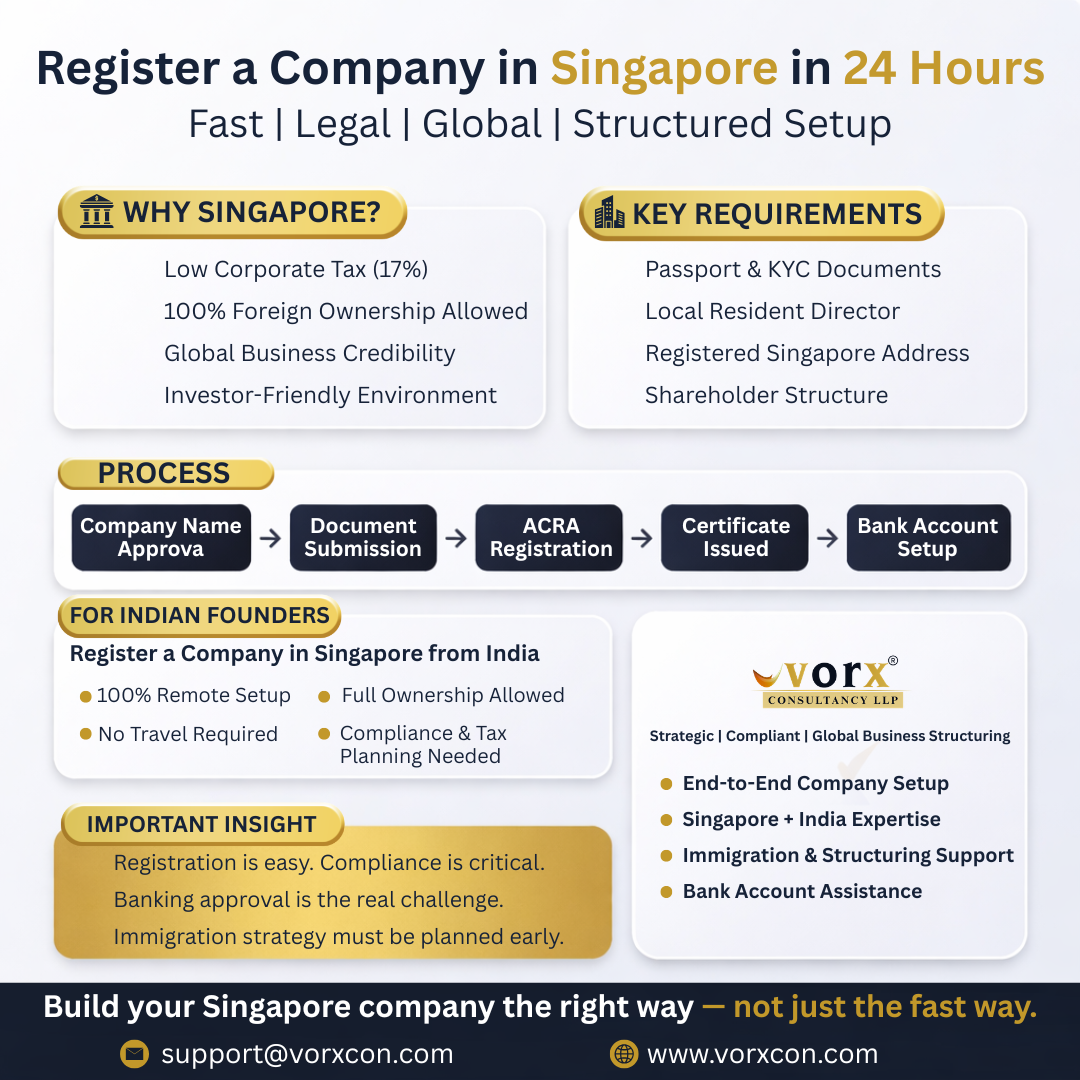
How long does it take to register a company in Singapore?
For most applicants, ACRA processes a Singapore company registration within 1 to 2 business days through the BizFile+ online portal. If the proposed company name contains sensitive words or requires referral to other government agencies, the process may take 14 to 60 days. Same-day incorporation is possible when all documents are in order and no referral is triggered.
Singapore consistently ranks as one of the easiest places in the world to start a business. The World Bank’s Ease of Doing Business Index placed Singapore among the top two globally for over a decade, and the country’s streamlined digital infrastructure means that company registration can be completed in as little as one to two business days.
For entrepreneurs targeting the Asia-Pacific region, Singapore offers a unique combination of political stability, robust legal protections, low corporate tax rates, and access to a market of over 4 billion people across ASEAN and broader Asia.
This guide provides a complete walkthrough of the company registration process in Singapore as of 2026, covering the most common entity type (the Private Limited Company, or Pte Ltd), all required steps from name reservation through post-incorporation compliance, realistic timelines and costs, and the ongoing obligations that every founder must understand.
Our research team has compiled this information from current ACRA regulations, the Companies Act 1967, and practical experience with the BizFile+ portal.
Why Singapore Is a Top Jurisdiction for Company Formation
Singapore’s appeal as a business jurisdiction extends far beyond its geographic location. The city-state has built an ecosystem specifically designed to attract and support businesses of all sizes, from solo founders to multinational corporations.
Singapore processes over 70,000 new company incorporations annually, reflecting the depth and maturity of its business ecosystem. With a corporate tax rate of 17%, no capital gains tax, and an extensive network of over 90 double taxation agreements, the jurisdiction offers structural tax advantages that compound over time for growing businesses.
The legal system is based on English common law, providing familiarity and predictability for international entrepreneurs. Intellectual property rights are rigorously protected, contracts are enforced efficiently, and the judiciary is widely regarded as impartial.
The country’s banking system is among the strongest in Asia, with three major local banks (DBS, OCBC, UOB) offering comprehensive corporate banking services.
For entrepreneurs considering where to base their Asian operations, Singapore’s advantages include 100% foreign ownership with no requirement for local partners, a minimum paid-up capital of just SGD 1, no foreign exchange controls, and a transparent regulatory environment.
The country’s strategic position as a gateway between East and West makes it an ideal hub for businesses serving customers across Asia, the Middle East, and beyond.
For a detailed comparison of available business structures, see our guide on Singapore Pte Ltd vs Sole Proprietorship vs LLP.
Types of Business Structures Available in Singapore
Before beginning the registration process, you must select the appropriate legal entity. Singapore offers several options, each suited to different business models, capital levels, and compliance appetites.
Private Limited Company (Pte Ltd)
The Pte Ltd is the most popular business structure in Singapore, accounting for the vast majority of new incorporations. It is a separate legal entity from its shareholders, providing full limited liability protection.
A Pte Ltd can have between 1 and 50 shareholders, must have at least one director who is ordinarily resident in Singapore, and requires a company secretary appointed within 6 months of incorporation. The minimum paid-up capital is SGD 1.
Sole Proprietorship
A sole proprietorship is the simplest and least expensive structure to set up, requiring only registration with ACRA. However, there is no legal separation between the owner and the business, meaning the owner is personally liable for all debts and obligations. Business income is taxed at the owner’s personal income tax rate (up to 22%) rather than the corporate rate (17%).
Limited Liability Partnership (LLP)
An LLP combines elements of a partnership and a company. Partners enjoy limited liability protection (each partner is not liable for the negligence of other partners), while the LLP itself has a separate legal identity. LLPs are commonly used by professional services firms such as law practices and accounting firms.
Branch Office and Representative Office
Foreign companies can establish a branch office in Singapore to conduct business activities directly, though the branch is not a separate legal entity from the parent company. A representative office is limited to market research and liaison activities and cannot engage in commercial transactions.
For most foreign entrepreneurs and startups entering the Singapore market, the Private Limited Company (Pte Ltd) is the default choice. It provides full liability protection, access to Singapore’s startup tax exemptions, eligibility for government grants, and the credibility needed to open bank accounts and secure contracts with larger businesses.
Overview of Key Requirements
| Requirement | Private Limited Company (Pte Ltd) | Sole Proprietorship |
|---|---|---|
| Minimum Shareholders/Owners | 1 | 1 |
| Maximum Shareholders | 50 | 1 |
| Minimum Paid-Up Capital | SGD 1 | Not applicable |
| Local Director Required | Yes (at least 1 ordinarily resident) | Not applicable |
| Company Secretary Required | Yes (within 6 months) | Not required |
| Registered Address | Required (Singapore address) | Required (Singapore address) |
| Liability Protection | Full limited liability | No protection (personal liability) |
| Tax Rate | 17% corporate rate with exemptions | Personal income tax rate (up to 22%) |
| Annual Filing | Annual return with ACRA | Not required (but income tax filing needed) |
| Estimated Formation Timeline | 1-2 business days | Same day |
| ACRA Registration Fee | SGD 315 | SGD 115 |
Step-by-Step Pte Ltd Registration Process
Step 1: Reserve Your Company Name
Before incorporation, you must reserve your proposed company name through ACRA’s BizFile+ online portal. The name application fee is SGD 15, and approval is typically instant if the name does not contain restricted words or require referral to other government agencies. The reserved name is valid for 120 days (extendable for another 60 days).
Your company name must not be identical to an existing registered entity, must not be obscene or vulgar, and must not infringe on existing trademarks. Names containing words such as “bank,” “finance,” “insurance,” “law,” or “media” may require approval from the relevant regulatory authority before the name can be reserved.
Step 2: Prepare the Required Documents
The following documents must be prepared before filing the incorporation application:
- Company constitution (formerly known as the Memorandum and Articles of Association)
- Consent to act as director from each proposed director
- Consent to act as company secretary (if appointed at incorporation)
- Declaration of compliance from the incorporating person
- Registered office address details
- Shareholder details and share allocation
For a standard Pte Ltd with a single shareholder and simple structure, ACRA provides a model constitution that can be adopted without modification. Companies with multiple shareholders or complex arrangements should engage a corporate lawyer to draft a customized constitution.
Step 3: Identify Your Local Director
Every Singapore Pte Ltd must have at least one director who is ordinarily resident in Singapore. This means the person must be a Singapore Citizen, Singapore Permanent Resident, or holder of an Employment Pass, EntrePass, or Dependant Pass. There is no maximum limit on the number of directors.
Foreign entrepreneurs who do not yet reside in Singapore have two primary options: appoint a nominee local director through a corporate service provider (costing SGD 2,000 to SGD 3,500 per year) while arranging their own work visa, or partner with a Singapore-based co-founder who can serve as the local director.
Most serious entrepreneurs use the nominee director as a temporary measure while applying for an Employment Pass or EntrePass to serve as director themselves.
Step 4: Secure a Registered Address
The company must maintain a registered office address in Singapore that is open and accessible to the public during ordinary business hours. This cannot be a P.O. Box. The address is publicly listed on the ACRA register.
If you do not have physical office space, you can use a registered address service from a corporate service provider, typically costing SGD 200 to SGD 500 per year. Some providers bundle the registered address with other services such as mail forwarding and company secretary.
Step 5: Appoint a Company Secretary
Every Singapore company must appoint at least one company secretary within 6 months of incorporation. The company secretary must be a natural person (not a corporate entity) who is ordinarily resident in Singapore. If the company has only one director who is also the sole shareholder, that person cannot also serve as the company secretary.
The company secretary is responsible for ensuring the company complies with the Companies Act, maintaining statutory registers, filing annual returns with ACRA, and organizing board and shareholder meetings. Most small companies engage a professional corporate secretarial firm for SGD 300 to SGD 600 per year.
Step 6: File the Incorporation Application on BizFile+
With all documents prepared, file the incorporation application through ACRA’s BizFile+ portal (www.bizfile.gov.sg). The incorporation fee is SGD 300 (in addition to the SGD 15 name reservation fee, totaling SGD 315).
The application can be filed by the proposed company officer (director or secretary), a registered filing agent (law firm, accounting firm, or corporate service provider), or through the ACRA service bureau. Most foreign entrepreneurs use a filing agent, as access to BizFile+ requires a SingPass or CorpPass account.
Step 7: Receive Your Incorporation Certificate and UEN
Upon approval, ACRA issues an electronic Certificate of Incorporation and assigns a Unique Entity Number (UEN) to the company. The UEN serves as the company’s identification number for all government transactions, tax filings, and regulatory submissions. There is no physical certificate issued; the electronic notification constitutes the official confirmation.
Post-Incorporation Requirements
| Task | Deadline | Cost |
|---|---|---|
| Open a corporate bank account | Within first few weeks (no legal deadline) | Varies by bank |
| Register for GST (if applicable) | Within 30 days of exceeding SGD 1M turnover | Free |
| Apply for necessary business licenses | Before commencing regulated activities | Varies by industry |
| Register for CPF (when hiring employees) | Before first salary payment | Free |
| Appoint company secretary | Within 6 months of incorporation | SGD 300-600/year |
| Appoint auditor (if required) | Within 3 months of incorporation | SGD 2,000-8,000/year |
| File estimated chargeable income (ECI) | Within 3 months of financial year end | Free (included in tax prep) |
| Send financial statements to members | Within 5 months of financial year end | Administrative cost only |
| File annual return with ACRA | Within 7 months of financial year end | SGD 60 |
Opening a Corporate Bank Account
One of the first practical steps after incorporation is opening a corporate bank account. Singapore’s three major local banks (DBS, OCBC, UOB) all offer business banking services, with account opening typically requiring an in-person visit by at least one director.
Required documents include the Certificate of Incorporation, company constitution, board resolution, and identification documents for all directors and signatories.
For a detailed guide on banking options and requirements, see our guide on opening a business bank account in Singapore.
Tax Registration
Your company is automatically registered for corporate income tax with the Inland Revenue Authority of Singapore (IRAS) upon incorporation. You do not need to separately register for corporate tax. However, if your taxable turnover exceeds or is expected to exceed SGD 1 million, you must register for Goods and Services Tax (GST) within 30 days.
For a comprehensive overview of corporate tax obligations, see our guide on Singapore corporate tax. For GST specifics, see our Singapore GST guide.
Business Licenses and Permits
Depending on your industry, you may need to obtain specific licenses before commencing operations. Common examples include a food shop license from the Singapore Food Agency, a travel agent license from the Singapore Tourism Board, a financial adviser license from MAS, and an employment agency license from MOM.
Check the GoBusiness Licensing portal for a comprehensive list of licenses applicable to your business activities.
Timeline: How Fast Can You Incorporate?
The fastest possible timeline for a straightforward incorporation is same-day registration through BizFile+. In practice, most incorporations are completed within 1 to 2 business days when all documents are in order and the company name does not trigger a referral.
Factors that can delay the process include names containing restricted words (14 to 60 days for referral), foreign directors without an existing Singapore ID (additional verification), complex shareholding structures involving corporate shareholders, and industries requiring pre-approval from regulatory agencies.
The practical timeline for most foreign entrepreneurs, including preparation of documents, engagement of a corporate service provider, name reservation, and incorporation filing, is 3 to 7 business days from initiation to receiving the Certificate of Incorporation. Founders who have all their documents ready and use an experienced filing agent can complete the process in 1 to 2 days.
Common Mistakes to Avoid
Many first-time founders in Singapore encounter avoidable issues during and after incorporation.
The most common include forgetting to appoint a company secretary within the 6-month deadline, using a residential address as the registered office without proper authorization, failing to maintain proper accounting records from day one, not understanding the distinction between paid-up capital and authorized capital, and underestimating the compliance costs of running a Pte Ltd compared to a sole proprietorship.
Understanding the full cost picture is essential before committing to incorporation. For a complete breakdown of formation and ongoing costs, see our guide on the cost of starting a business in Singapore.
Singapore Company Formation for Different Entrepreneur Profiles
Tech Startups
Singapore actively supports technology startups through programs such as Startup SG Founder (SGD 50,000 grant), incubator and accelerator support, and the EntrePass visa for innovative entrepreneurs. Tech startups should consider the startup tax exemption, which provides significant tax savings in the first three years.
For details on available grants and funding, see our guide on Singapore startup grants.
E-Commerce Businesses
E-commerce businesses benefit from Singapore’s position as a logistics hub with excellent connectivity to ASEAN markets. GST registration is mandatory if annual turnover exceeds SGD 1 million, including sales to Singapore customers. The Free Trade Zones can be leveraged for inventory management and re-export operations.
Professional Services
Consultants, agencies, and professional service firms can operate effectively as a Pte Ltd or LLP. The Pte Ltd structure is preferred when seeking external investment or government grants, while the LLP may suit partnerships that prefer pass-through taxation.
Foreign Holding Companies
Singapore is a popular jurisdiction for holding companies due to its extensive network of over 90 double taxation agreements, no capital gains tax, and the foreign-sourced income exemption scheme. Holding company structures require careful planning to maximize treaty benefits and comply with substance requirements.
Conclusion
Registering a company in Singapore is a straightforward process that can be completed in 1 to 2 business days through ACRA’s BizFile+ portal. The combination of low minimum capital requirements (SGD 1), a transparent digital registration system, and a supportive regulatory environment makes Singapore one of the most accessible jurisdictions for company formation globally.
The key requirements are at least one locally resident director, a Singapore registered address, and a company secretary within 6 months. Total formation costs, including government fees and basic professional services, typically range from SGD 1,000 to SGD 3,000 for a straightforward Pte Ltd incorporation.
With its 17% corporate tax rate, generous startup exemptions, and strategic position as Asia’s premier business hub, Singapore remains an outstanding choice for entrepreneurs building businesses with regional or global ambitions.
Related Corpy Resources
- Singapore business guide for a full overview of doing business in Singapore
- Company formation in Singapore for related articles on this topic
- Corporate tax in Singapore to explore adjacent considerations
- Business laws in Singapore to explore adjacent considerations
- Free zones in Singapore to explore adjacent considerations
How to do company registration online in Singapore?
Singapore Pte Ltd registration online through ACRA’s BizFile+ portal costs SGD 315 (SGD 15 name reservation + SGD 300 incorporation fee) and completes in 15 minutes to 2 business days.
Requirements: at least one director ordinarily resident in Singapore (citizen, PR, or EP holder - nominee director services cost SGD 1,500 to SGD 3,000/year for non-residents), a company secretary appointed within 6 months (SGD 300 to SGD 800/year), a registered Singapore office address (cannot be PO Box - SGD 300 to SGD 1,000/year for service addresses), and at least SGD 1 issued share capital.
Steps: reserve name in BizFile+ (SGD 15, 1 hour), prepare constitution (template available free), appoint directors and company secretary, submit BizFile+ application (SGD 300), receive Certificate of Incorporation same-day.
Post-registration: register for CorpPass (digital government ID), open a bank account with DBS, OCBC, or UOB (2 to 6 weeks), and register for GST if annual turnover exceeds SGD 1M.
How to get incorporation documents online in Singapore?
Singapore incorporation documents are delivered electronically through ACRA’s BizFile+ portal immediately after successful Pte Ltd registration.
For SGD 315 in total state fees (SGD 15 name reservation + SGD 300 incorporation), applicants receive a Certificate of Incorporation (eCoI) as a PDF, a Business Profile (BizFile extract) showing the current company details, and the Constitution (template version if using ACRA defaults).
Timeline: 15 minutes to 2 business days depending on ACRA automated review vs manual check triggered by certain business activities (regulated sectors take longer). All documents are digitally signed by ACRA and legally equivalent to paper certificates.
Bank account opening (DBS, OCBC, UOB typically 2 to 6 weeks in-person; ANEXT, Aspire, Wise Business 1 to 5 days remote), CorpPass setup (digital government ID for the company), and GST registration (required above SGD 1M turnover) follow incorporation. For comparison, Delaware LLC delivers Certificate of Formation in 1 to 10 days; UK Ltd delivers incorporation certificate same-day for £50.
How to open a Chase business bank account online from Singapore?
Chase does not offer fully remote international business banking - Chase Business Complete requires in-person visits to a US Chase branch for account activation.
For Singapore-based founders operating a US LLC, the Chase path is: form a US LLC (Delaware $110 + $300/year, Wyoming $100 + $60/year), obtain free EIN from IRS (4 to 8 weeks by fax for Singaporeans without SSN), schedule a US trip, visit a Chase branch with LLC Certificate of Formation, EIN confirmation, and passport.
Chase Business Complete: $15/month (waivable with $2,000 balance or $2,000 monthly debit). Timeline post-visit: 1 to 3 business days. For Singapore founders avoiding US travel, fintech alternatives are standard: Mercury (fully remote, 5 to 10 days, free, $0 monthly), Relay (remote, 5 to 10 days, free), Wise Business (1 to 5 days, SGD 0 + multi-currency setup).
Singapore Pte Ltd formation via ACRA BizFile+: SGD 315 (SGD 15 + SGD 300) plus corporate secretary SGD 300 to 800/year plus nominee director SGD 1,500 to 3,000/year for non-residents. For Singapore Pte Ltd with US customers, the practical setup is Mercury + US LLC (Delaware or Wyoming) rather than Chase - avoids the US travel requirement.